SsD

architecture + urbanism

SsD at Modern Atlanta

You need to install or upgrade Flash Player to view this content, install or upgrade by clicking here.

SsD's video 'Bicycle Ride' is an animated survey of our recent work and is on exhibit at the Modern Atlanta Museum.  A special thanks to Manifesto Architecture who curated and designed the exhibit.  Also thanks to the 'inep+ 93nii' at xarrier for creating the original music – more collaborations with them in the near future…

The idea that architecture is beyond what can be represented in still images has haunted our recent work.  We have recently explored animation as a means to describe the passage of time: the changes brought on by people inhabiting the spaces, the impact of natural elements, the idea of process. But the question remains -  how does one communicate  transformation, experience, and phenomenon, in a globalizing economy where the exchange value of pure imagery remains a driving force?  In fact, even with the promise of the internet and 'multi-media,' the iconic still-frame still drives (and limits) how architecture is represented – perhaps even more so today.  Our own work however is moving from three dimensions to incorporating the fourth dimension of time:  How can the sequence of moving through the spaces be part of the everyday existense of the building? How can the architecture itself be abstract enough, not for abstraction's sake, but in the service of allowing multiple readings and uses? Instead of a series of still images, perhaps our portfolio should become a flip-book.

White Block Gallery is Completed

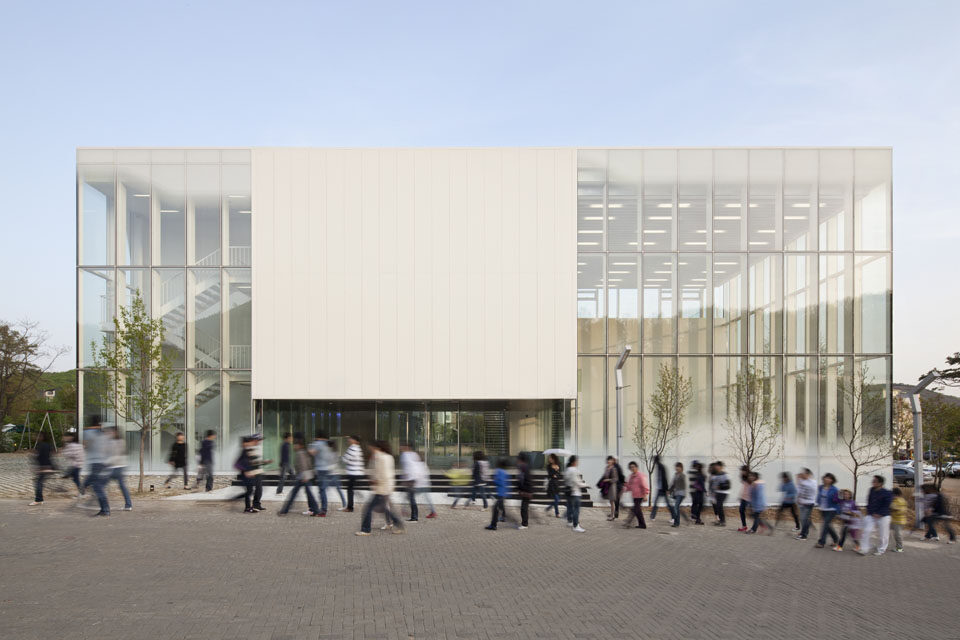
 Less than 2 years ago we won the competition for the White Block Gallery.  In retrospect it feels like the project leapt from paper to reality.  Its successful completion is critical on many fronts -  It was our first building in Korea, and it was our first free-standing arthouse.  We have a lot of people to thank along the way, many of whom we hope to have credited on the project team list.  Most of all, the experience has been invaluable and we're now tooled and ready for what's next: to take on more projects in Asia, and to step further into doing work that can bring a positive effect on the public life of our cities, both at the scale of the individual and at the scale of the larger urban framework.

>> more info

White Block ‘Supercore’ Completed

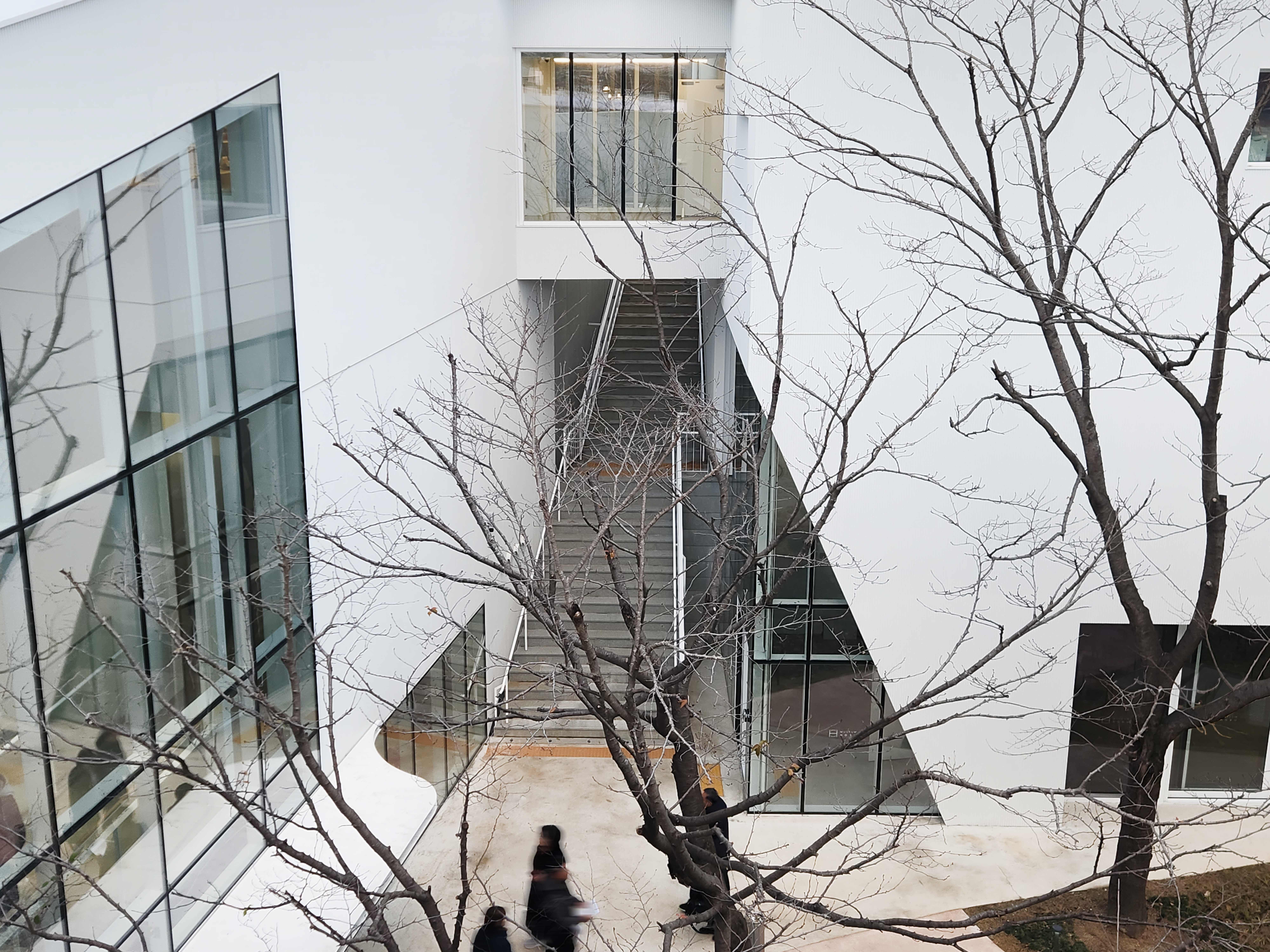
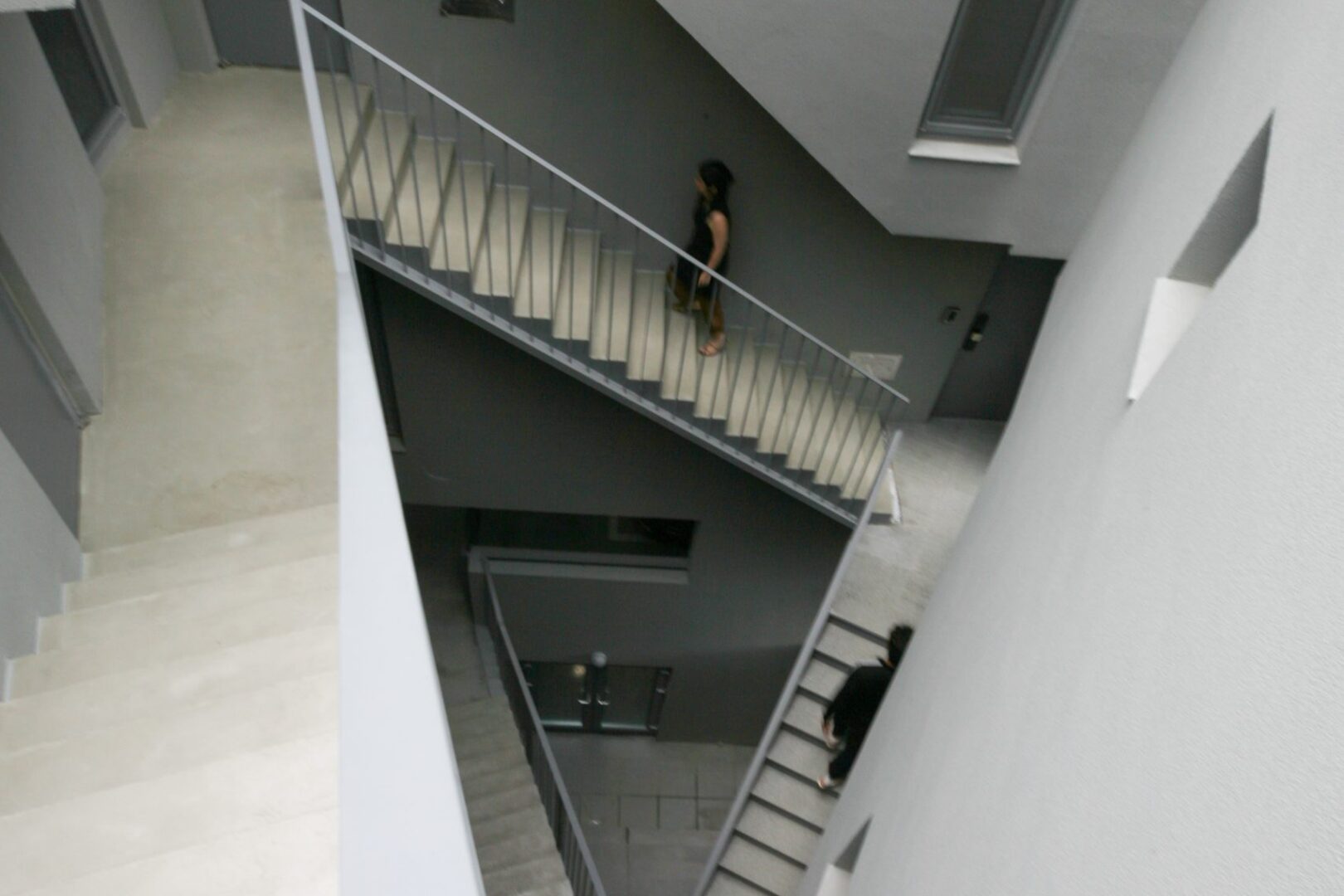
The stairs and railing of the ‘super core’ have been installed at White Block. This main vertical core of the building allows the varied gallery spaces a sense of interior intensity while simultaneously linking them to the exterior topographic condition.  As one progressively moves through a series of volumes, one is reoriented toward the immediate environment.

As all the galleries are adjacent to this core, motorized vents allow a constant flow of air, passively ventilating the entire building.

Curved Glass at White Block Installed

The curved glass entry has been installed at the White Block Gallery.  A shallow curve that includes glass pivot doors is difficult to achieve.  Some doubted it could be done at all, but we pushed for it and the fabricator ended up even surprising themselves.  Signalling entry within an otherwise taut building skin, the geometry is a precursor to the sequence of choreographed spaces:  the compressed entry hall, the tall super-core, and the landscape and pond in the distance…

White Fog

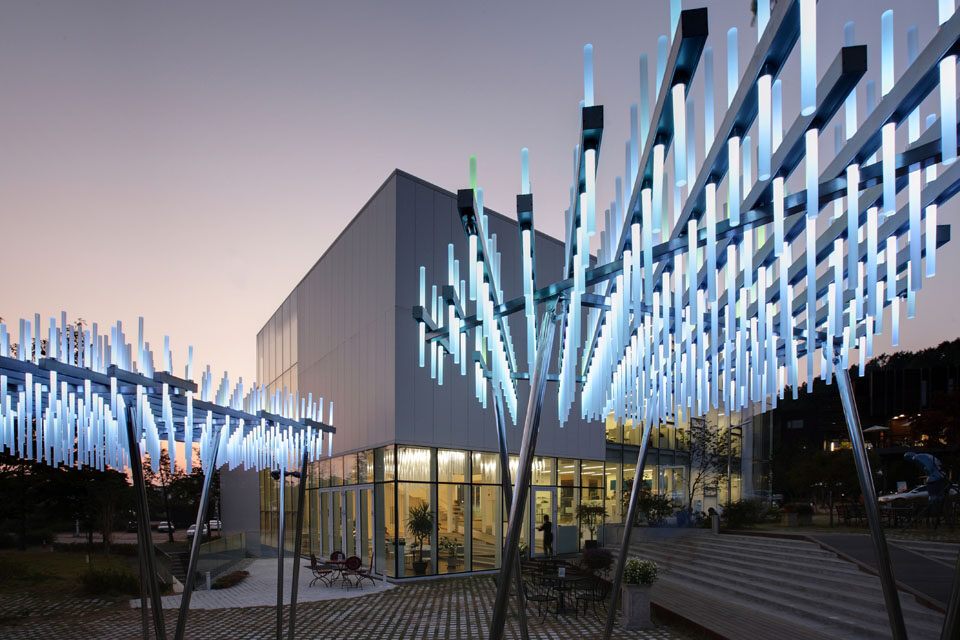
In the early hours of dawn, fog descends often in the Heyri Art Valley. The curtain wall installation of the White Block Gallery nears completion:  The fritted glass pattern works in many different ways  - as the environment dynamically changes, the way the building is perceived also shifts.

Shading with Patterns at White Block

The glazing at White Block Gallery is nearing completion.  We are very excited about our custom fritted glass pattern which encloses all of the transparent parts of the building.  Seemingly simple, the gradation works in multiple different ways:  It shades the space during the warmer summer months while allowing in the low winter sun for passive heating.  It also filters views to the outside giving the larger galleries a sense of interior intimacy while allowing controlled views to the natural surrounds. From the exterior it lends the building many complex readings: sometimes reflecting and augmenting the landscape and sometimes allowing views to the interior logic of the structural system.

Clover Restaurant is completed

The first of the Clover Restaurants is open at Harvard Square at 7 Holyoke.  Not only was it a privilege collaborating with Clover on a new concept for fast food, it was also a privilege working in the Holyoke Center, the Harvard owned building designed by Josep Lluís Sert.  Our approach was to combine the minimum-footprint-aesthetic of the Clover brand with the abstract spatial concepts of Sert’s space:  Like a minimalist art installation, fluorescent ‘cloud canopies’ are suspended below the original waffle ceiling.  A void cut into the existing mezzanine brings natural light from a skylight above while a wire trellis will allow climbing ivy to eventually reach this light source.  The idea of transparency is both literal and figural: The boundary between ‘kitchen’ and ‘customer’ is dissolved to reveal the workings of the food-making while the use of glass railings also allows visual communication between spaces while reflecting and multiplying the light.

Clover is part of a larger concept for tasty, vegetarian fast food. Their (and our) mission is to revolutionize the way food is produced, distributed, and ultimately consumed - because if we can do so, it will have an enormously positive impact on the environment.  This is not just ‘greenwash,’ in fact if you look at modern food systems you will notice enormous dysfunction on many interrelated levels.  Because of the sheer scale of our current state of affairs, a slight shift will make revolutionary change.  The clover food trucks which rolled out earlier last year are part of this larger network.  Also check out Clover on the web.

Last chance to see Convergent Flux

This is the final week of the exhibit, Convergent Flux: Korea at the Korea Society, an interactive exhibition on contemporary Korean architecture, landscape architecture, and urban design first shown at the Harvard GSD, curated by Jinhee Park and John Hong. Please feel free to visit the gallery at: 950 3rd Avenue, 8th Floor, New York, NY 10022.  We will keep you posted on the future of the exhibit content…

White Block is unwrapped

We started the New Years at Heyri by unwrapping what seemed like a giant, building-sized present:  Due to the harshest winter in Korea in 30 years, the Gallery White Block has been completely covered for the last 6 weeks and work has been delayed.  And just like opening a holiday gift we were at first incredulous, eager and elated.  But soon we realized that what was inside was not quite as advertised.  The curtain wall had not been installed exactly as we specified. Nothing that some old-school, on-site brainstorming (and headbutting) can’t fix…

SsD featured in ‘The New Modern House’

The Big Dig House was recently featured in Jonathan Bell’s and Ellie Stathaki’s The New Modern House: Redefining Functionalism.


The Center for Arts at the Armory is completed

In terms of preservation strategies, armories are truly a difficult urban building type.  Once a place for military training, they are now becoming almost wholly obsolete:  Their vast interior drill hall and their monumental footprint makes them difficult to convert to any other urban program including housing.  Meanwhile, many of them appear on highly restrictive state or national historic registers.  This confounds developers further as surrounding land costs and thus development intensity has multiplied around these buildings but the restrictions placed on renovating them makes it impossible to increase their density and make the numbers work.

The Somerville Armory is one such building.  Nestled in an otherwise dense residential zone, it sat underutilized for years, slowly deteriorating.  After the building was courageously acquired by the Highland Avenue Trust, we worked with them, the Arts at the Armory, the City of Somerville, and the Massachusetts State Historical Commission to adaptively re-use the structure into a  regional, 30,000 sf non-profit arts center that houses a multitude of community oriented programs including NGO’s, artists, dance, and music studios and offices, galleries, arts education and after school programs, and a cafe/performance space.  The building’s anchor is the former drill hall which now serves as a multi-use space that host a variety of community programs, concerts, and educational venues.

Braver House completed

The Braver House  is an alternative for older suburbs where houses are being built to the setback line creating buildings much too big for their lots.  Instead we designed a small footprint house but built a screen to the maximum setback line.  This allows indoor spaces to extend to the exterior and also allows us to drastically reduce potable water use by eliminating a good portion of the suburban grass lawn.