SsD

architecture + urbanism

New Images of Korea Society Exhibit

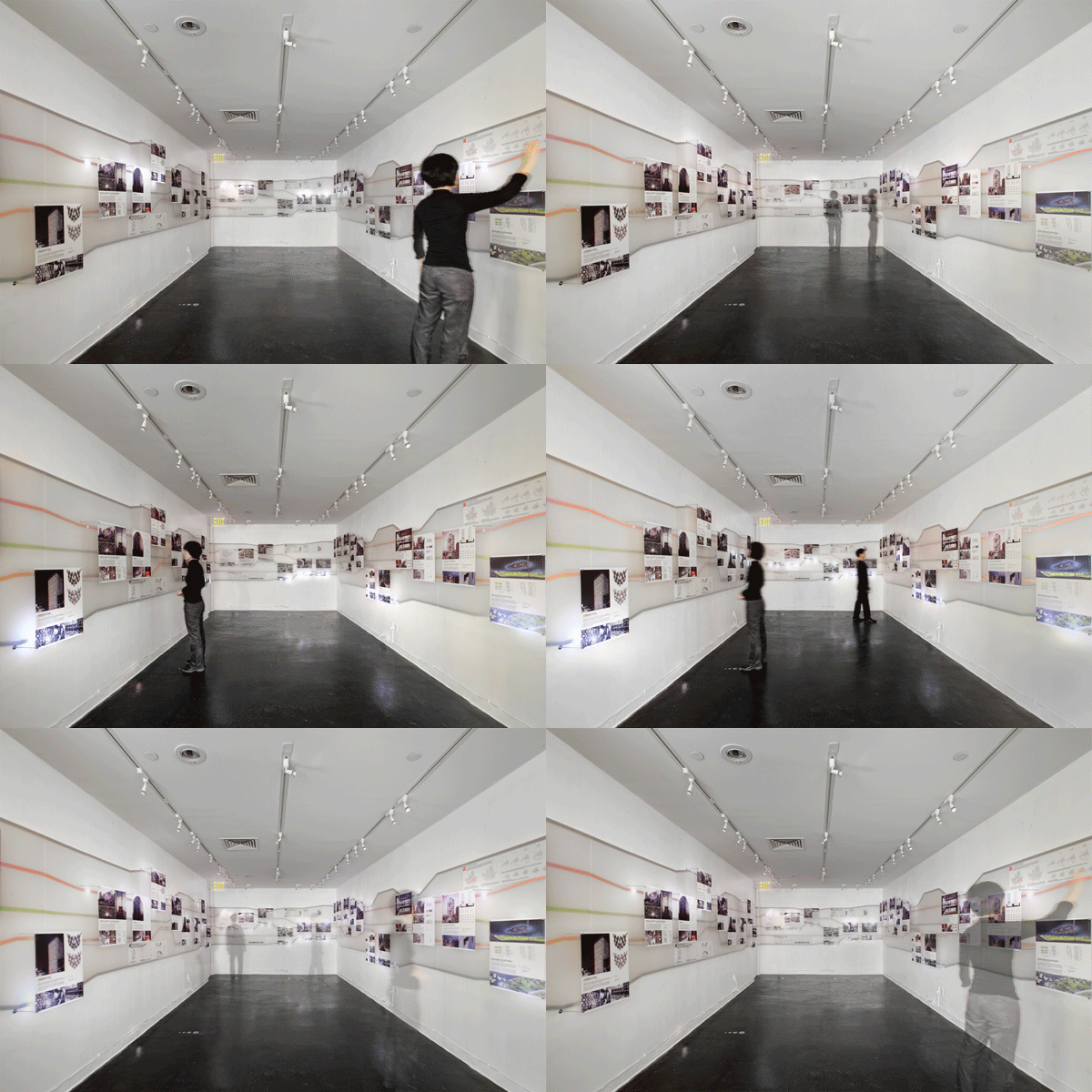
Last year we put on a 'mini' version of the Covergent Flux: Korea exhibit at the Korea Society in New York and we finally got around to putting the images on our website (yes, we are very behind on updates which thankfully means we're busy with projects!). The contents were originally was shown at the Harvard GSD two years ago where it was the first cross-disciplinary exhibit on Korea architecture, landscape architecture, and urban design mounted in the United States. The challenge of the Korea Society version was that in a space 10 times smaller than the GSD's Gund Hall gallery we had to condense the complex information into something legible without oversimplifying the issues. The other major challenge was to honor all the designers that participated in the original exhibit by not editing out any of the projects. Our solution was to use motion sensors triggering LED's so that when one walks around the room, the changing illumination patterns relate the project to the 5 organizing themes as well as to each other. Shifting to an even smaller scale, we are preparing for the launch of the book version of Convergent Flux: Architecture and Urbanism in Korea, in the upcoming new year. Please stay tuned…


Share Button

Convergent Flux – Korea Society

Convergent Flux: Korea Society New York | 2011

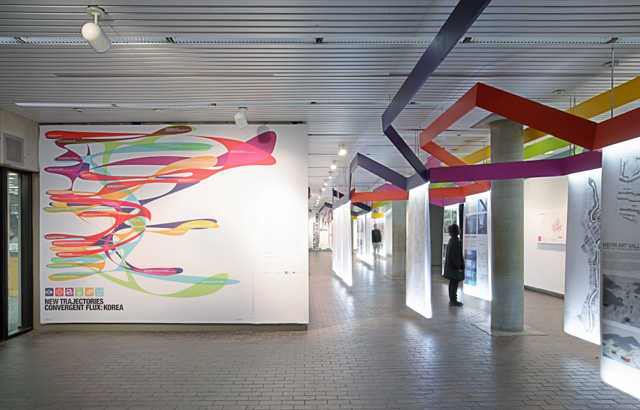
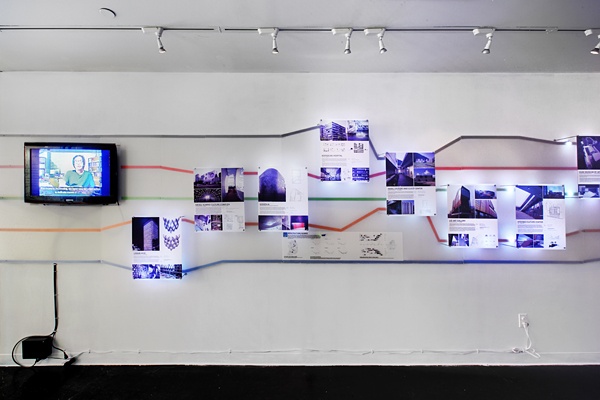
Stemming from a research project and exhibition at the Harvard Graduate School of Design, this interactive exhibition staged at the Korea Society examines contemporary Korea's architecture, landscape architecture, and urban design. The twenty-nine projects shown exemplify five interrelated themes that continue to shape modern Korea's development. The topics of historical transformation, accelerated density, topographical syntax, material identity, and infrastructural alliance, are mapped onto the wall as trajectories that converge and diverge. By utilizing a series of motion sensors that illuminate panels of information, visitors are encouraged to interactively explore each project and its relation to the themes and other projects. In parallel with the exhibit, Jinhee Park and John Hong moderated a series of lectures which included Marion Weiss and Michael Manfredi as well as organized and moderated a roundtable discussion with Taewook Cha, Felipe Correa, Mark Rakatansky, and Soo-In Yang. The research has culminated in the book, Convergent Flux: Contemporary Architecture and Urbanism in Korea.


5 themes represented by colored lines organize the exhibited projects.


The images float in front of the wall while the organizing themes appear as lines running continuously around the room.
 

Lighting behind the panels react to users' movement showing the interrelationship between projects and the 5 organizational themes. 90 minutes of video interviews with the designers give personal context to the work.
 

dot_grey
PROJECT CREDITS:

curators
Jinhee Park  + John Hong

exhibit design and fabrication
Jinhee Park AIA + John Hong AIA, LEED AP (principals in charge)
Frederick Peter Ortner, Juho Lee, Natalee Newcombe, Joe Watson

a special thanks to:
Harvard GSD, The Korea Society, The Architectural League of New York


RELATED PROJECTS:

bac-sasaki mass college of art    
bac sasaki mass art convergent flux    

dot_grey

print post print post
Share Button

8 Towers in Bregenz

A massive model of the Ordos 100 project is on exhibit at the Kunsthaus Bregenz – Our '8 Towers' proposal is in the foreground.  Seeing the entire complex in a uniform and 'ready-made' material is sublime evidence of the innovative efforts of Ordos 100 curator Ai Wei Wei, who is the feature of the overall exhibit. Throughout the ongoing repression of the artist's efforts, we applaud his provocative influence that bridges art and architecture with the political and the social.  // thanks to Florian Idenburg of so-il for the photograph. //

Share Button

SsD at Modern Atlanta

SsD's video 'Bicycle Ride' is an animated survey of our recent work and is on exhibit at the Modern Atlanta Museum.  A special thanks to Manifesto Architecture who curated and designed the exhibit.  Also thanks to the 'inep+ 93nii' at xarrier for creating the original music – more collaborations with them in the near future…

The idea that architecture is beyond what can be represented in still images has haunted our recent work.  We have recently explored animation as a means to describe the passage of time: the changes brought on by people inhabiting the spaces, the impact of natural elements, the idea of process. But the question remains -  how does one communicate  transformation, experience, and phenomenon, in a globalizing economy where the exchange value of pure imagery remains a driving force?  In fact, even with the promise of the internet and 'multi-media,' the iconic still-frame still drives (and limits) how architecture is represented – perhaps even more so today.  Our own work however is moving from three dimensions to incorporating the fourth dimension of time:  How can the sequence of moving through the spaces be part of the everyday existense of the building? How can the architecture itself be abstract enough, not for abstraction's sake, but in the service of allowing multiple readings and uses? Instead of a series of still images, perhaps our portfolio should become a flip-book.

Share Button

Last chance to see Convergent Flux

This is the final week of the exhibit, Convergent Flux: Korea at the Korea Society, an interactive exhibition on contemporary Korean architecture, landscape architecture, and urban design first shown at the Harvard GSD, curated by Jinhee Park and John Hong. Please feel free to visit the gallery at: 950 3rd Avenue, 8th Floor, New York, NY 10022.  We will keep you posted on the future of the exhibit content…

Share Button

Convergent Flux, Korea opens at the Korea Society

Please join us for the opening reception and roundtable for the NY installation of the exhibit, Convergent Flux, Korea first shown at the Harvard Graduate School of Design.

Opening Reception and Panel Discussion
Panel: Taewook Cha, Felipe Correa, Mark Rakatansky, and Soo-In Yang, moderated by Jinhee Park and John Hong
Tuesday, December 7, 2010
6:00 p.m. – 9:00 p.m. (panel at 7:00 p.m.)
The Korea Society
950 Third Avenue, 8th Floor

A special thanks to the Harvard GSD, The Korea Society, and The Architectural League of New York for collaborating in sponsoring this event. 

Photo above:  Interactive electronics are being installed by Peter Ortner and Juho Lee of SsD who worked long hours over the weekend to install the exhibit.  Natalee Newcombe (Program Officer of Contemporary Issues at the Korea Society) and Joe Watson also provided crucial help and coordination in the installation.

Share Button

Infinite Box

Gwangju Biennale, Korea | 2009
[curators' selection for full scale construction]
    

One of 20 'rest box' designs selected by the curators of the Gwangju Design Biennale in Korea for full scale construction, the Infinite Box is a response to both the literal site of the nearby Soswaewon Gardens as well as the garden's metaphysical site embodied in the work of poet-scholar Kim Inhu who immortalized the Soswaewon's qualities in a 48 verse poem.  Our project treads this fine boundary between the actual and the metaphysical  through inextricably collapsing the boundary between the preconceptions of this dichotomy.  From the exterior, the box reads as a singular form with carved out voids. Upon discovering the interior however, an inversion occurs where the voids now become perceivable as figural objects through their reflection against the 6 mirrored interior planes. Thus, the destabilization of void-solid,  finite-infinite as one passes from outside the box to its interior and vice versa inspires new understandings of interior-exterior, mind-body, object-field, architecture-landscape.


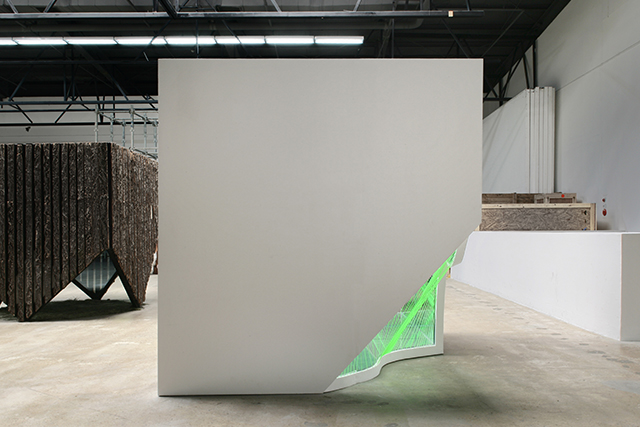
From the exterior, the infinite box appears as a finite form with figural voids subtracted out of a platonic and comprehensible solid mass.


Siteplan:  From within, one realizes that the bounded box is actually sitting in a conceptually infinite field.


Upon entering the box, the idea of interiority is reversed so that instead of an enclosed and compact room, the mirrored surfaces create an expansive landscape that recalls the Soswaewon forest.


Changing views transform the reflected patterns in differing, unexpected ways.  The conceptual inversion continues: The mirrors create figures from what was a void when viewed from the exterior.  The combination of shifting forms connote the clouds, rain, dense leaves, ponds of water that make up the Soswaewon gardens.


The viewer is placed in an infinite field.  However the way the mirrored planes reflect the fluorescent lines and voids create surfaces of orientation that reference conditions of ground and sky while dissolving conditions of wall.


One of the openings was designed for the scale of the child.  The view through the pavilion questions the dichotomy between interior and exterior.

dot_grey
PROJECT CREDITS:

architect
Jinhee Park AIA + John Hong AIA/LEED (principals in charge), Eunkyoung Kim, Marcela Delgado, Mijung Kim, Virginie Bonnet, Frederick Peter Ortner

exhibit curator and coordinator
Byoungsoo Cho, BCHO architects associates

fabricator Han Design Group Co., Ltd.

photography
Wooseop Hwang (exteriors)


RELATED PROJECTS:

asian cultural complex czech library  hbny white stadium
acc czech library hbny white stadium convergent flux

dot_grey


print post print post
Share Button

Convergent Flux Korea

Harvard University, Gund Hall Gallery | 2010

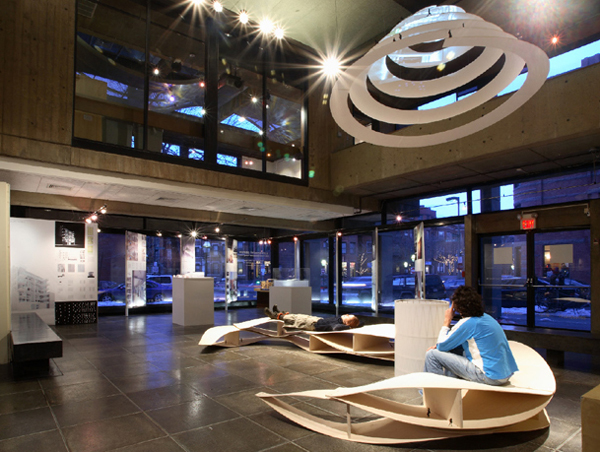
Curated by Jinhee Park and John Hong, the exhibit emerged from a semester-long research project with students from the Harvard Graduate School of Design. As the first cross-disciplinary exhibition on Korean Architecture, Landscape Architecture, and Urban Planning and Design mounted in the United States, the featured work exemplifies the interrelated trajectories that mark the contemporary condition in Korea: Six organizational operatives—historical transformation, accelerated density, topographical syntax, material identity, ecological intersection, and infrastructural alliance—map the individual works in a relational field. While this synthetic structure delineates the rich and specific sociocultural ground from which the projects emerge, it also provides a transferability of the concepts embodied in the work to other situations beyond the boundaries of this particular nation. Finally, these mappings allow a temporary critical pause within the accelerated production that allows us re-evaluate the work and positively shape its future evolution. The contents of the exhibit are now available in book titled, Convergent Flux: Contemporary Architecture and Urbanism in Korea.


The exhibition draws from the continuously emerging and hybridized condition in contemporary Korean society that has offered such a fertile and dynamic territory for experimentation. The six trajectories converge and diverge organizing the projects in momentary relationships that open up a ground for discussion and critique.

The 6 trajectories begin from the endwall:  as they converge, they become both literal and conceptual intersections from which the content is structured.  As the space moves linearly through the gallery, the hanging panels define 'rooms' where one can pause and form relationships between the projects.  The static content on the walls become further describe each of the six trajectories.
 

View from main entry: the project panels are first understood as a single elevation.


Quotes from the designers, video interviews, and data on Korean urban phenomena are placed on the walls to inform the project panels.


Mohsen Mostafavi, Dean and Alexander and Victoria Wiley Professor at the Harvard Graduate School of Design, introduces the exhibit on opening night, February 5th, 2010.
 

The culminating event was the symposium, 'Convergent Flux: Extended Topographies and the Korean Urban Condition,' in Piper auditorium at the Harvard GSD.  Seung H-Sang, Pai Hyung Min, Suh Hailim, and Park Yoonjin each presented and enganged in a discussion with Jinhee Park and John Hong.


dot_grey
PROJECT CREDITS:

Mohsen Mostafavi, Dean, Alexander and Victoria Wiley Professor of Design Pat Roberts, Executive Dean Hannah Peters, Associate Dean of External Affairs

curators
John Hong, Adjunct Associate Professor Jinhee Park, Lecturer in Architecture, Landscape Architecture, and Urban Planning and Design

advisor
Hailim Suh, Lecturer in Architecture, Landscape Architecture, and Urban Planning and Design

exhibition research and design team
(GSD seminar participants under the direction of the curatorial team with Hailim Suh and the Exhibitions Department of the GSD). Christina Cho, Kent Gould, Mark Holmquist, Okhyun Kim, Sooran Kim, Clara Lee, Jinje Lee, Moran Lee, Greg GhunWhan Park, Gyoung Tak Park, Terry Sung Park, Hyun Ji Ryu, John Son, Jeong Jun Song, Kyung Ho Won, Hyun Tek Yoon, Hyung Jae Yu, Seung Ho Choi (photographer)

exhibition team
Dan Borelli, exhibitions Shannon Stecher, Exhibitions and Publications Melissa Vaughn, Publications

GSD fabrication and installation team
Frank Braman, Jef Czekaj, Alex DeMaria, Jack Mauch, Jared May, Reid Schwartz, Dave Stuart, Joanna Vouriotis

historical advisor
Jin Baek, Associate Professor, Seoul National University

GSD event photographer
Aaron Orenstein

supporting organizations
Space Magazine, Harvard University, Choi DuNam, Korean Ministry of Culture, Sports and Tourism


RELATED PROJECTS:

bac-sasaki mass college of art    
bac sasaki mass art korea society    

dot_grey

print post print post
Share Button

New Trajectories: Convergent Flux, Korea opens at Harvard

This Friday, February 5th at 530pm there will be an opening reception of the exhibit, New Trajectories: Convergent Flux, Korea at the Harvard GSD Gund Hall lobby.  We hope you can join us to celebrate the event.

Convergent Flux, Korea is the first cross-disciplinary exhibition on Korean Architecture, Landscape Architecture, and Urban Planning and Design mounted in the United States.  The contents of the exhibition draw from the continuously emerging and hybridized condition in contemporary Korean society that has offered such a fertile and dynamic territory for experimentation.  Twenty-eight recent projects that exemplify the rising distinction seen in Korean design work will be displayed in relationship to the complex contemporary issues that inform the work.

The exhibition is co-curated by John Hong and Jinhee Park with Hailim Suh as advisor.

Here is a summary of events associated with the exhibit:

Exhibition Opening:  New Trajectories: Convergent Flux, Korea
Feb. 5th / 5:30 pm / Gund Hall Lobby

Lecture: City Compound
Unsangdong (Jang Yoon Gyoo + Shin Chan Hoon, Reigh Youngbum)
Feb. 8th / 6:30 pm / Piper Auditorium

Lecture: Speed and Architecture
KYWC Architects (Kim Seung Hoy)
Feb. 16th / 6:30 pm / Piper Auditorium

Panel Discussion: Covergent Flux: Extended Topographies and the Korean Urban Condition
Pai Hyung Min, Park Yoon Jin, Seung H-Sang, Suh Hailim
Feb. 22nd / 6:00 pm / Piper Auditorium

Share Button

White Stadium

Seoul, Korea | 2008
[finalist, invited competition]

white stadium sdo

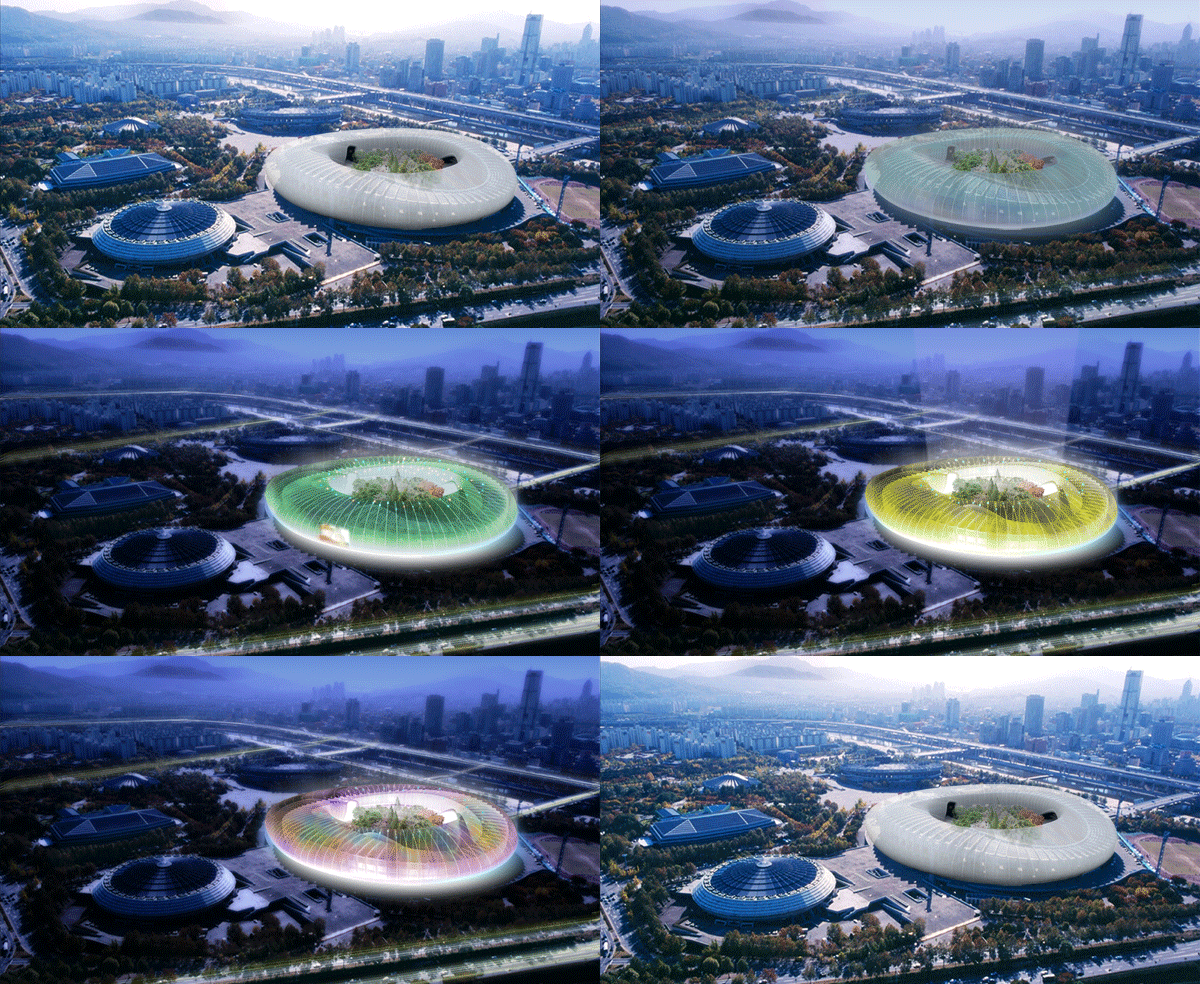
Water, digital technology, and sustainability are merged in this new reinterpretation of the iconic but now underutilized Seoul Olympic Stadium.  A temporary structure to house the international Seoul Design Olympiad (SDO) events, an inflatable arch is held away from the structure of the historic stadium.  Through a simple process of condensing water on the surface of this inflatable structure through solar evaporation, rain runoff is purified and ‘misted’ to create a white volume that catches digital light and defines new energized events.  The mist also nourishes a nursery of culturally significant trees within the center of the stadium.  At the end of the event, these trees are placed throughout the city of Seoul according to the city’s masterplan, extending the positive memory of the white stadium.


sdo baekja

Inspired by the simple and elegant pottery of the Baek-Ja era, the stadium becomes a new urban figure.  By using an inflatable structure combined with a simple process of condensing water in sunlight within the inflatable,  the mist at times hides the stadium and then allows it to reappear giving the existing building a new sense of life.

white stadium section
As the stadium fronts the Hangang River, contaminated water from the river is purified through the condensation process and used to water a grove of trees.

The simple process of purifying water through condensation is demonstrated.

white stadium trees

The nursery of trees is then relocated to different parts of Seoul according to the city's masterplan.  The alliance of the two major municipal projects creates an overall savings for the city.

white stadium detail

The  purified water is used for irrigation as well as well as for creating atmospheric mists for events.

white stadium  waterfront

View from the Han River: Changing patterns of white mist illuminated by LED's define the underutilized existing stadium as a new event space.  The purification of the water into mist allows the public to understand the importance of the river.


PROJECT CREDITS:

architect
Jinhee Park  AIA + John Hong  AIA, LEED (principals in charge), Frederick Peter Ortner, Chris Ryan, Leehong Kim, Jaeyoon Kim, Chang Zhang

structural engineer
Paul Kassabian, SGH


RELATED PROJECTS:

asian cultural complex czech library boston harbor pavilion cade museum  
acc czech library boston harbor cade museum  

dot_grey
< back to:   works cultural


print post print post

Share Button

SsD’s ‘infinite box’ is featured in the Gwangju Biennale

SsD’s submission for the Gwangju Design Biennale in Korea was one of 20 boxes selected internationally to be built and exhibited  full scale.  The exhibit opens 18 Sept 2009 and continues through 4 November.

Share Button

8 Towers exhibited at ART Basel

Ordos 100
The inevitable cultural negotiations
when building a city in the 21st Century


art basel

An exhibition on architecture, urbanization and globalization

with 100 architectural designs including SsD’s 8 Towers
with photographs by Maurice Weiss

During ART Basel

June 10th – 14th, 2009
Open daily 5PM-8PM

Opening June 10th, 5PM-8PM

www.ordos100basel.info

E-Halle Basel, Erlenstrasse 15
For directions: www.e-halle.ch

For more information: ordos [at] territorialagency [dot] com

Share Button