SsD

architecture + urbanism

Curved Glass at White Block Installed

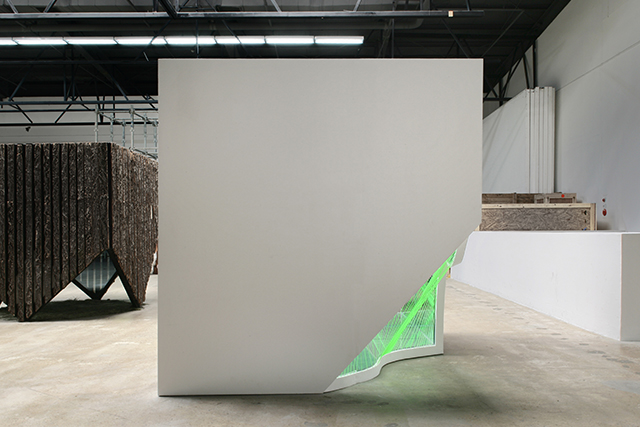
The curved glass entry has been installed at the White Block Gallery.  A shallow curve that includes glass pivot doors is difficult to achieve.  Some doubted it could be done at all, but we pushed for it and the fabricator ended up even surprising themselves.  Signalling entry within an otherwise taut building skin, the geometry is a precursor to the sequence of choreographed spaces:  the compressed entry hall, the tall super-core, and the landscape and pond in the distance…

Share Button

Shading with Patterns at White Block

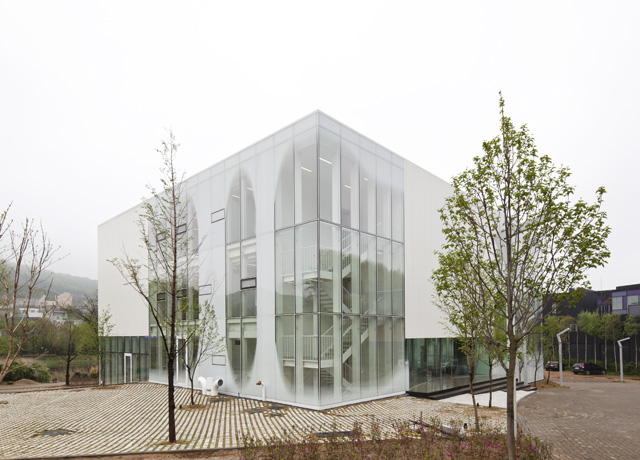
The glazing at White Block Gallery is nearing completion.  We are very excited about our custom fritted glass pattern which encloses all of the transparent parts of the building.  Seemingly simple, the gradation works in multiple different ways:  It shades the space during the warmer summer months while allowing in the low winter sun for passive heating.  It also filters views to the outside giving the larger galleries a sense of interior intimacy while allowing controlled views to the natural surrounds. From the exterior it lends the building many complex readings: sometimes reflecting and augmenting the landscape and sometimes allowing views to the interior logic of the structural system.

Share Button

Clover Restaurant is completed

The first of the Clover Restaurants is open at Harvard Square at 7 Holyoke.  Not only was it a privilege collaborating with Clover on a new concept for fast food, it was also a privilege working in the Holyoke Center, the Harvard owned building designed by Josep Lluís Sert.  Our approach was to combine the minimum-footprint-aesthetic of the Clover brand with the abstract spatial concepts of Sert's space:  Like a minimalist art installation, fluorescent 'cloud canopies' are suspended below the original waffle ceiling.  A void cut into the existing mezzanine brings natural light from a skylight above while a wire trellis will allow climbing ivy to eventually reach this light source.  The idea of transparency is both literal and figural: The boundary between 'kitchen' and 'customer' is dissolved to reveal the workings of the food-making while the use of glass railings also allows visual communication between spaces while reflecting and multiplying the light.

Clover is part of a larger concept for tasty, vegetarian fast food. Their (and our) mission is to revolutionize the way food is produced, distributed, and ultimately consumed - because if we can do so, it will have an enormously positive impact on the environment.  This is not just 'greenwash,' in fact if you look at modern food systems you will notice enormous dysfunction on many interrelated levels.  Because of the sheer scale of our current state of affairs, a slight shift will make revolutionary change.  The clover food trucks which rolled out earlier last year are part of this larger network.  Also check out Clover on the web.

Share Button

White Block Gallery

Heyri, Korea | 2011
[ AIANE Design Award, AIA/BSA Honor Award, American Architecture Award ]

The White Block Gallery is a 1500m2 exhibition and cultural space at the heart of the Heyri Art Valley in South Korea. A matrix of 3 solid gallery volumes carefully positioned creates 7 additional galleries in a compact but open ended configuration. Designed to showcase global contemporary art from super sized sculpture and paintings to multi-media installations, the spaces are unique in proportion and lighting allowing curators to accommodate new future forms of art and media. Integration with the landscape of the prominent lake-front site is also of crucial importance: The result places the intense and controlled experience of art side-by-side with informal social and landscape interactions. Passive heating and ventilation are integrated into the art house’s high efficiency environmental systems and runoff control measures become part of the spatial experience of art.


By carefully arranging the massing of 3 solid gallery volumes, 7 more galleries are produced in the interstitial spaces to create a total of 10 proportionally varied galleries.


View of exterior: solid and void galleries are suspended in a dense matrix white maintaining views through the building.

The fritting pattern takes on more figural volumes to create areas of privacy and publicity.  The shapes merge with the patterns of early morning fog.  A functional space of the fire stair becomes a main feature as a public viewing platform at the building’s corner.
 

As the largest site in the Heyri Art Valley, the aggregation of solid and transparent boxes breaks down the overall scale of the building.  Each solid gallery box is thought of as a pavilion that is either suspended above the landscape or placed on top of it. The solid boxes capture shadows of adjacent trees while the transparent boxes reflect the distant landscape. A roofdeck on the lower ‘sitting box’ has extended views to the natural surrounds.


A compressed entry under the hovering ‘hanging box’ frames views to the waterfront beyond.  The low space is accentuated through the use of dark woods and in juxtaposition to the tall ‘supercore’ it connects to.  The entry glass is the only curved moment in the otherwise taut skin and allows one to occupy an ambiguous space between inside and outside
.

The ‘Supercore’ is an organizational void space that mediates between the autonomy of each gallery space and its connection to the surrounding landscape.  A series of bridges cross the space and become viewing platforms for artwork.


A variety of gallery spaces range in volume, lighting conditions and interconnectedness.


Unfolded section: Instead of evenly dividing up the building into 3 stories (top), the section through the building is conceived of as an interior topography (bottom), that allows exhibition spaces to vary radically in height while maintaining strict overall building height zoning regulations.


The interior ‘ground’ is conceived of as a topography that is directly linked to the landscape design.  Formal galleries for art are adjacent to informal social spaces.  The ‘stramp’ (stair and ramp hybridized) also doubles as a lecture hall and screening room.


Linked directly to the 'stramp' the 'supercore’ is an organizational void space that mediates between the autonomy of each gallery space and its connection to the surrounding landscape.  A series of bridges cross the space and become viewing platforms for artwork.


The 'supercore' and 'stramp' occupy a large window that spatially connects the front and back of the building and  reorients views to the lake and wetlands.


"High" and "low" tech strategies are used for daylighting: A parametrically developed frit pattern optimizing for daylight distribution while minimizing heat gain. (above-right). City-regulated blooming trees become part of the shading strategy in their ability to change seasonally. As the frit pattern moves from opaque to transparent, exterior trees appear to shift from outside to inside (above right and below).


Column Study: The structure is distributed across many smaller columns rather than a few larger ones increasing the visual connection between interior to the site as well as providing more curatorial freedom for the gallery spaces by eliminating structural obstructions.


As part of the larger urban and landscape setting, existing exterior paths are integrated into the interior circulation.


PROJECT CREDITS:

architect
Jinhee Park  AIA + John Hong  AIA, LEED (principals in charge)
Frederick Peter Ortner, Donguk Lee, Jiseok Park, Taesoo Kim, Christoph Schäfer, Juho Lee, Marcela Delgado, Soojung Rhee, Aleta Budd, Okhyun Kim, Eli Allen, Jeff Niemasz, Eunkyoung Cho, Brian Vester, Ryan Welch, Jeong Jun Song

associate architect
Dyne Architects

structural design
Matt Johnson, SGH Inc.

structural engineer
New Engineering

lighting consultant
Project Concept K

construction manager
Hanmi Parsons Co., Ltd.

photography
Chang Kyun Kim


RELATED WORKS:

czech library coulter house asian cultural complex  
infinite box czech library coulter house acc  

dot_grey

print post print post

Share Button

Infinite Box

Gwangju Biennale, Korea | 2009
[curators' selection for full scale construction]
    

One of 20 'rest box' designs selected by the curators of the Gwangju Design Biennale in Korea for full scale construction, the Infinite Box is a response to both the literal site of the nearby Soswaewon Gardens as well as the garden's metaphysical site embodied in the work of poet-scholar Kim Inhu who immortalized the Soswaewon's qualities in a 48 verse poem.  Our project treads this fine boundary between the actual and the metaphysical  through inextricably collapsing the boundary between the preconceptions of this dichotomy.  From the exterior, the box reads as a singular form with carved out voids. Upon discovering the interior however, an inversion occurs where the voids now become perceivable as figural objects through their reflection against the 6 mirrored interior planes. Thus, the destabilization of void-solid,  finite-infinite as one passes from outside the box to its interior and vice versa inspires new understandings of interior-exterior, mind-body, object-field, architecture-landscape.


From the exterior, the infinite box appears as a finite form with figural voids subtracted out of a platonic and comprehensible solid mass.


Siteplan:  From within, one realizes that the bounded box is actually sitting in a conceptually infinite field.


Upon entering the box, the idea of interiority is reversed so that instead of an enclosed and compact room, the mirrored surfaces create an expansive landscape that recalls the Soswaewon forest.


Changing views transform the reflected patterns in differing, unexpected ways.  The conceptual inversion continues: The mirrors create figures from what was a void when viewed from the exterior.  The combination of shifting forms connote the clouds, rain, dense leaves, ponds of water that make up the Soswaewon gardens.


The viewer is placed in an infinite field.  However the way the mirrored planes reflect the fluorescent lines and voids create surfaces of orientation that reference conditions of ground and sky while dissolving conditions of wall.


One of the openings was designed for the scale of the child.  The view through the pavilion questions the dichotomy between interior and exterior.

dot_grey
PROJECT CREDITS:

architect
Jinhee Park AIA + John Hong AIA/LEED (principals in charge), Eunkyoung Kim, Marcela Delgado, Mijung Kim, Virginie Bonnet, Frederick Peter Ortner

exhibit curator and coordinator
Byoungsoo Cho, BCHO architects associates

fabricator Han Design Group Co., Ltd.

photography
Wooseop Hwang (exteriors)


RELATED PROJECTS:

asian cultural complex czech library  hbny white stadium
acc czech library hbny white stadium convergent flux

dot_grey


print post print post
Share Button

SsD’s ‘infinite box’ is featured in the Gwangju Biennale

SsD’s submission for the Gwangju Design Biennale in Korea was one of 20 boxes selected internationally to be built and exhibited  full scale.  The exhibit opens 18 Sept 2009 and continues through 4 November.

Share Button

Soft Lofts

Brooklyn, NY | 2007

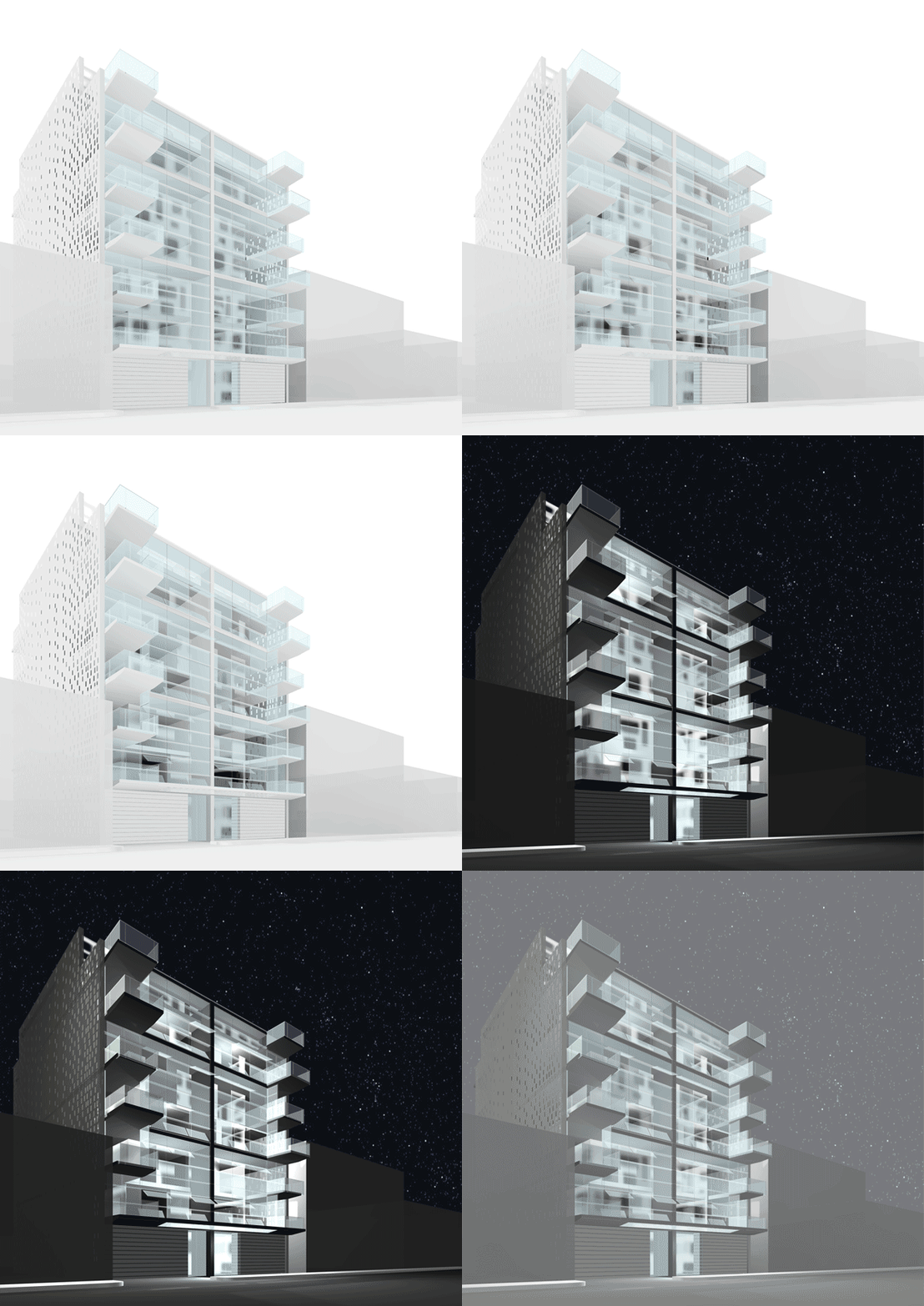
Rather than consider ‘Urban’ and ‘Soft’ as contradictory concepts, this project rethinks the terms as counterparts to one another. Instead of a series of windows that polarize notions of inside and outside, two transformable layers are utilized: The outer skin becomes a system of operable clear windows while the inner skin utilizes sliding panels with printed ‘windows’ that transition between clear and opaque. The space that is captured between these layers is a kind of ‘soft’ zone – neither outside nor inside, but a gradation between the two. From the interior, the additional perceptual depth allows users to innovate previous conceptions of the domestic.

soft lofts


softlofts-typology
  soft lofts typology model

Typological Transformations:  1.  The old-law 'railroad' tenement had little access to light and air. 2.  The new-law 'dumbell' tenement enforced small unnocupiable lightwells. 3.  Along with the rear-yard setback, soft lofts proposes a 'soft' perimeter of occupiable light and air spaces.  existing zoning
Existing Zoning: Low 1 or 2 story warehouses are the defining characteristic that have attracted new residents(left).  The new zoning implies complete erasure with 5 or 6 story new construction.

softlofts - proposed zoning
Suggested Zoning: By not lowering the proposed FAR, new construction could still be spliced into the existing fabric (left).   The sidewall could become a new layer  of history among the existing warehouse streetfronts.

soft party wall

The sidewall (or party wall) can become a new surface for bringing in light as well as an elevation that participates tangentially with the surrounding urban scene.  As only 15% of this wall can be glazed per code, the wall can be more effective as an overall distributed pattern rather than as a few isolated openings.


softlofts section softlofts panels

A skip-stop elevator allows duplex units.  The double-height soft zone between the interior and exterior is defined by sliding panels that can be configured by the user to  naturally vary the environmental performance and transparency of the space.


dot_grey
PROJECT CREDITS:  

architect
Jinhee Park AIA, John Hong AIA/LEED (principals in charge), Frederick Peter Ortner, Erik Carlson, Anne Levallois, Sadmir Ovcina, Youngju Baik, Chris Minor, Hyeyoung Kim


RELATED PROJECTS:

 hbny mass college of art czech library    
hbny  mass art czech library    

dot_grey

print post print post
Share Button