Posts Tagged ‘recycling’

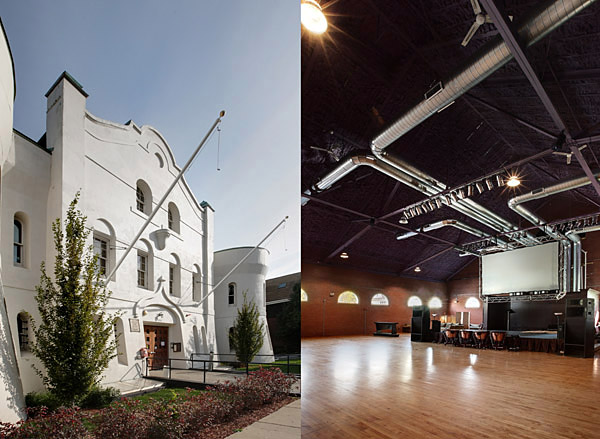
Mass College of Art

Saturday, March 14th, 2009

Boston, MA | 2007

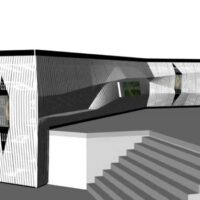
A new undulating screen of recycled polyester seat belts engages traffic flows while providing new places for the experience of education and the arts. The screen itself has a dual purpose: The vertical straps produce a Moiré illusion by interacting with a silk-screened base layer. These Moiré patterns convey information at the same time they animate the space through their movement and distortion. Secondly, the screen acts as a flexible infrastructure for hanging student, faculty, and community work. The polyester straps can be mounted onto or pulled aside to reveal display cases and video art.


Moiré Study: Interference patterns between a revealing layer and a base layer result in an optical illusion of magnification and mirroring. These phenomena allow us to create a deep illusionistic space in the narrow cavity between the existing walls of the building and the installed screen.


massart

The new programmed screen wall accomodates many aspects of student and community life (above).  The current existing lobby (below) is a dark provisional space that one merely passes through.


massart sections

Through configuring each of the seat belt profiles to accommodate specific functions, the new screen fluidly engages a continuous range of activities from personal to communal scales.


recycling seat belts
Polyester is the most widely used and produced polymer in the world making up around one half of all polymers produced.  Its advantage, the durability of the material, is also its environmental disadvantage.  In a landfill it will take most standard polyesters, such as those in seat belts, many thousands of years to biodegrade.  Although polyesters are in general highly recyclable, the process of doing so is energy intensive and releases new pollutants into the air and water.  In light of this it is important to not only re-use existing polymer based products, but to raise consciousness about their life-cycles.


massart plan

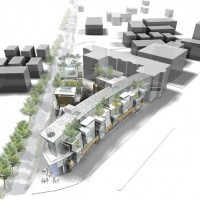
The existing lobby, originally seen as left over space, is transformed into a linear sequence of events (plan above, unfolded elevation below).


PROJECT CREDITS:

architect
Jinhee Park AIA, John Hong AIA, LEED (principals in charge), Frederick Peter Ortner, Catarina Marques

design detailing + fabrication
Loki Custom Furniture

structural engineer
Matt Johnson, SGH


dot_grey
index <  works cultural


print post print post

Big Dig Building

Sunday, February 22nd, 2009

Cambridge, MA | 2005
[ Metropolis Next Generation Prize, Holcim Sustainable Construction Award ]

Most are familiar with Boston’s ongoing “Big Dig.” Few, however, give thought to the massive amount of waste that accompanies construction on this scale, namely the dismantling of the existing and temporary roadways. The Big Dig Building proposes to relocate and recycle these infrastructural materials as building components, adapting them to uses ranging from structural members to cladding. Furthermore, as these reused materials can withstand much higher loads than conventional building elements, the social ramifications of “heavy” in relation to “dwelling” can produce new and innovative results.

big dig building

highway to housing

From Highway to Housing:  What happens to the millions of tons of discarded materials from obsolete infrastructures like Boston’s Big Dig?  Destroying it costs millions to tax payers as well as wastes the embodied energy already stored in the materials.   Dismantled and relocated, concrete and  steel sections can become structural building modules adaptable to a variety of sites and programs.


infrastructure to architecture

load comparison

Load Comparisons: Standard framing (left) can withstand 40 psf – only standard residential objects and programs can be accomodated. The existing highway overpass (middle) is designed for HS20-44 military loading and can withstand 250 psf. The Big Dig Building using salvaged materials could withstand 200psf – How might a structure that can sustain 4x the load of standard residential construction change the way we dwell?

big dig building from street

Highway panels are shifted to create an elevation that reads as a vertical landscape.


big dig typologies

Like a prefabricated system, differing typologies from low to high densities can be created from the same salvaged infrastructural materials.  In this light, should not all infrastructural materials be more strategically designed with the second use already in mind? This ‘pre-cycling’ of structure would save them from become obsolete (and thus regarded as trash) and would conserve their massive amount of embodied energy for the lifespan of the material.

big dig building section
Cross section:  The assembly of infrastructural materials provides advantages such as long span undergroung parking, the integration of water filled trombe walls, and the ability to incorporate full scale landscapes on roofs and balconies.


big dig building interior

Because of the ability for the materials to carry heavy loads as well as span long distances, new programmatic freedoms can evolve.  Family playgrounds can be introduced into upper level units to provide immediate access to the outdoors (left), libraries and other heavy loads can be sustained within each unit (middle), and long spans making continuities between inside and outside can be achieved (right).

PROJECT CREDITS:

architect
John Hong AIA/LEED,  Jinhee Park AIA (principals in charge), Erik Carlson, Gentaro Miyano

structural design
Paul Pedini, Jay Cashman, Inc.


RELATED PROJECTS:

big dig house soft lofts    
big dig house soft lofts  


dot_grey
index
<  works residential


print post print post

Big Dig House

Thursday, January 22nd, 2009

Lexington, MA | 2006
[AIA/BSA Housing Design Award, Metropolis Magazine Feature, Boston Globe Arts Feature, Business Week Feature]

As a prototype building that demonstrates how infrastructural refuse can be salvaged and reused, the structural system for this house is comprised of steel and concrete discarded from Boston’s Big Dig utilizing over 600,000 lbs of salvaged materials from elevated portions of the dismantled I-93 highway. Planning the reassembly of the materials in as if it were a pre-fab system, subtle spatial arrangements are created. These materials however are capable of carrying much higher loads than standard structure, easily allowing the integration of large scale roof gardens. Most importantly, the project demonstrates an untapped potential for the public realm: with strategic front-end planning, much needed community programs including schools, libraries, and housing could be constructed whenever infrastructure is deconstructed, saving valuable resources, embodied energy, and taxpayer dollars

bigdighouse_southeast_dusk

-

bigdighouse_inverset-load   bigdighouse_materials

Within 2 days, the house is framed: reusing steel structure and roadway panels from the big dig has sped up this phase of construction from 2 weeks to 12 hours.
-

bigdighouse_ne_3041

To minimize fabrication time and expense, the structural pieces were reused as-is.

-

bigdighouse_sequence4-small   bigdighouse_section

construction sequence (left) and section through living and roof garden (right).
-
-

bigdighouse_mezzanine_3294

Salvaged structural materials are left raw (left).  The roof garden connects to the living room and utilizes harvested rainwater (right).
-
-

bigdighouse_greatrm-easel_3268

Window walls in conjunction with double height spaces bring natural light deep in the space while exterior overhangs shade summer sun.


bigdighouse_nw_3039

-
-

dot_grey
PROJECT CREDITS:

architect
John Hong AIA /LEED, Jinhee Park AIA (principals in charge), Erik Carlson, Sadmir Ovcina, Chris Minor

structural design & construction
Paul Pedini, Jay Cashman, Inc.

structural engineer
Weidlinger Associates, Inc.

water management design
Cristina Perez-Pedini


RELATED PROJECTS:

big dig building mass college of art valentine houses
 
big dig bldg mass art valentine


dot_grey
index <  works residential


print post print post