2 December 2012
Convergent Flux: Korea Society New York | 2011

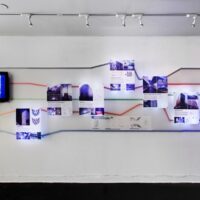
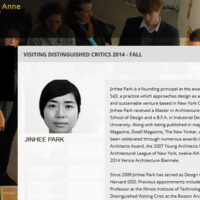
Stemming from a research project and exhibition at the Harvard Graduate School of Design, this interactive exhibition staged at the Korea Society examines contemporary Korea's architecture, landscape architecture, and urban design. The twenty-nine projects shown exemplify five interrelated themes that continue to shape modern Korea's development. The topics of historical transformation, accelerated density, topographical syntax, material identity, and infrastructural alliance, are mapped onto the wall as trajectories that converge and diverge. By utilizing a series of motion sensors that illuminate panels of information, visitors are encouraged to interactively explore each project and its relation to the themes and other projects. In parallel with the exhibit, Jinhee Park and John Hong moderated a series of lectures which included Marion Weiss and Michael Manfredi as well as organized and moderated a roundtable discussion with Taewook Cha, Felipe Correa, Mark Rakatansky, and Soo-In Yang. The research has culminated in the book, Convergent Flux: Contemporary Architecture and Urbanism in Korea.


5 themes represented by colored lines organize the exhibited projects.

The images float in front of the wall while the organizing themes appear as lines running continuously around the room.

Lighting behind the panels react to users' movement showing the interrelationship between projects and the 5 organizational themes. 90 minutes of video interviews with the designers give personal context to the work.

PROJECT CREDITS:
curators
Jinhee Park + John Hong
exhibit design and fabrication
Jinhee Park AIA + John Hong AIA, LEED AP (principals in charge)
Frederick Peter Ortner, Juho Lee, Natalee Newcombe, Joe Watson
a special thanks to:
Harvard GSD, The Korea Society, The Architectural League of New York

RELATED PROJECTS:

print post
14 October 2011

We are continuing to explore the theme of 'Light Monumentality' this semester with 12 talented students from the Harvard Graduate School of Design. The site of inquiry is the area surrounding Seoul Station where we have asked students to wrestle with contemporary terms of monumentality in the form of a design proposal for a new international rail station. With the inevitable opening of the border between North and South Korea, a trans-national railway will connect the Asian region with high-speed rail service and eventually future connections will even reach Europe.
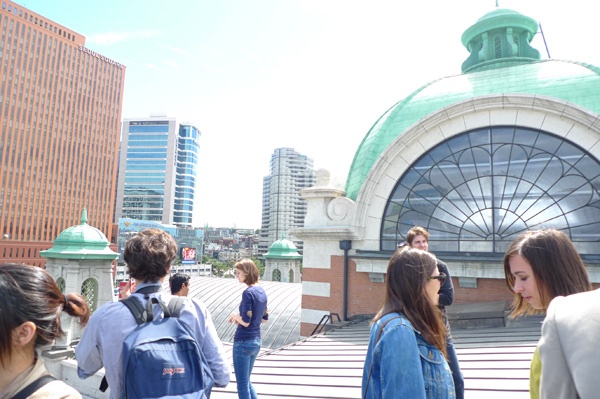
Professor and masterplanner Ahn Changmo gave an enlightening tour of the history and future of Seoul Station which culminated at the roof of the historical building. There we were able to get a panoramic view of the quickly transforming urban surrounds…
20 July 2011

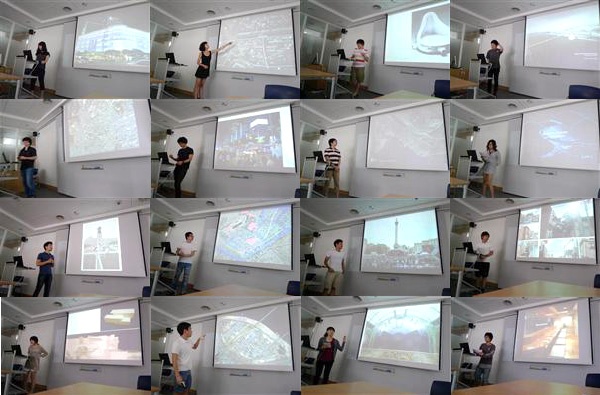
SNU students presented their final images for the 5-day 'Light Monumentality' workshop. Rather than the students initially explaining their intentions, in a pedagogical reversal we asked the critics to respond first by only reading into a single large scale image produced by each of the students. SNU Professors Kim Seung Hoy, Kim Jin Kyoon, Peter Ferretto, along with Prof. Choe Sangki from University of Seoul, and Park Yoonjin from Parkkim, quickly adjusted to the new situation, insightfully critiquing (and sometimes productively misreading) the student's intentions. Only afterwards were the students allowed to present additional drawings and verbally respond.
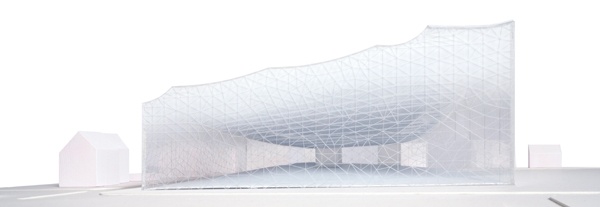
The reversed exercise was not only a lot of fun for all participants, it also reflected one of the key concepts of the workshop: That in monumental architecture, the image many times precedes the specifics of the architectural resolution: The concepts of the image, whether fabricated or real, inevitably become merged and conflated with the actualities of the architectural form to the point that the reality of the space is only fully understood through its image.
15 July 2011

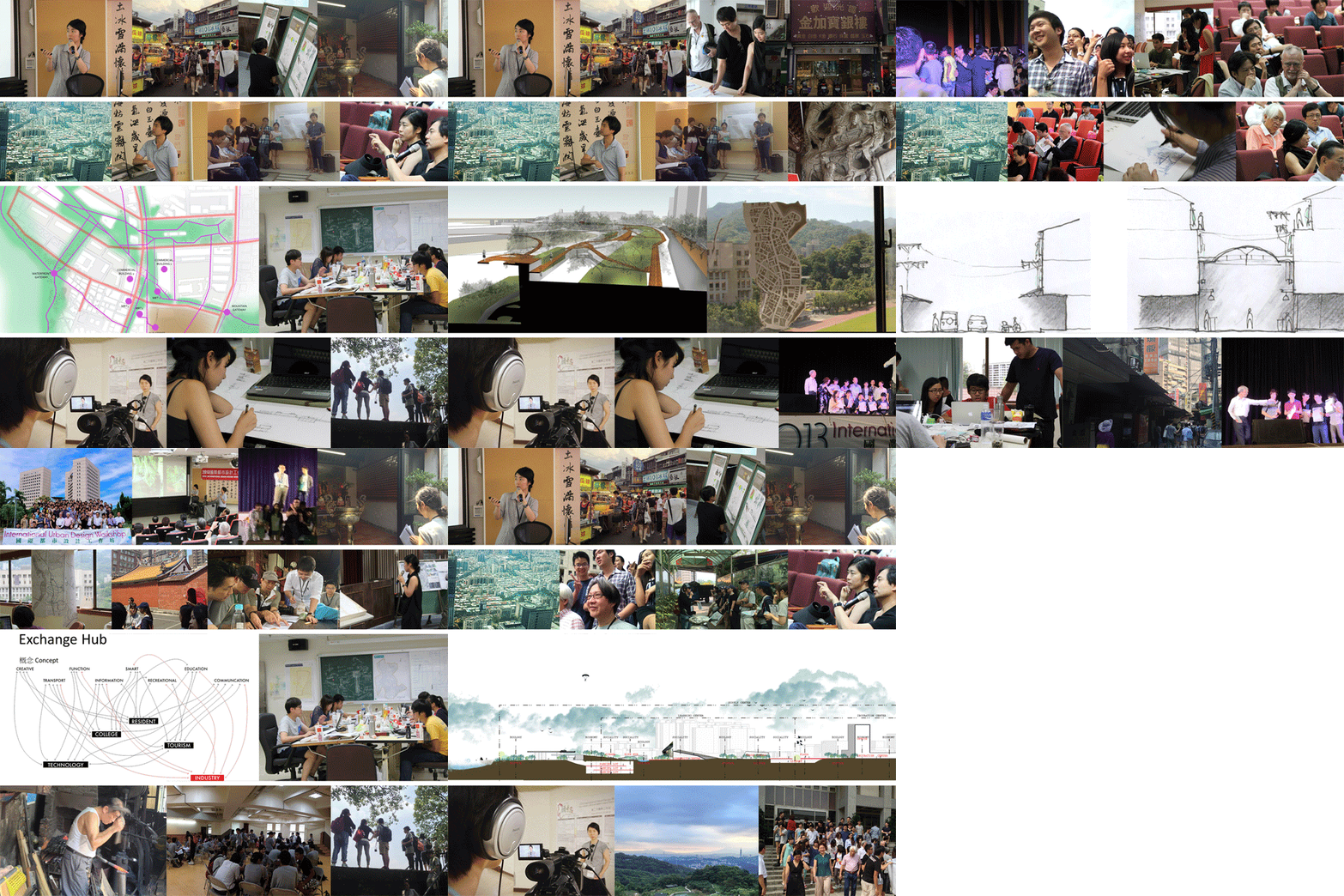
SsD was invited by Seoul National University's Department of Architecture to teach a 5-day workshop for their Frontline series. We posed the term 'Light Monumentality' to the students, a topic we have been exploring in our recent work. On the first day, students presented their interpretation of the term.
The workshop brief asks to the students to grapple with concept of monumentality in contemporary architectural terms: Who or to what power structure does a monument belong? How does the programmatic function align with its symbolic intent? Can the social content of the monument shift or does it remain aligned to a single power structure? We have intentionally juxtaposed the concept of lightness and monumentality to put the terms into question. We all understand that the monumental assumes a certain gravity, a staid materiality, a relationship to particular ideologies. However lightness conveys a different conceptual stream: the phenomenological qualities of natural light, lightness of ecological and energy footprints, lightness of contemporary tectonics that can no longer rely upon unlimited human labor, and lightness in terms of the speed of construction required by modern urbanization.
The Korean context is especially a significant backdrop to address these current issues. With the creation of new urban zones, each of these territories must compete for identity while attempting to generate a sense of publicity within a constantly evolving social and cultural climate. Architecture then plays a central role as it communicates the larger agendas of these new urban entities. It is instrumental in communicating the aspirations and the ideas of a larger public sphere. At the same time it must also be flexible in the context of a quickly transforming society.
11 July 2011

Please join us for the lecture 'Light Monumentality' at Seoul National University, 7pm, School of Architecture, 5th Floor. The lecture is part of SNU's annual Frontline workshops. This year SsD is teaching a design workshop at SNU examining contemporary issues of monumentality.
7 December 2010

Please join us for the opening reception and roundtable for the NY installation of the exhibit, Convergent Flux, Korea first shown at the Harvard Graduate School of Design.
Opening Reception and Panel Discussion
Panel: Taewook Cha, Felipe Correa, Mark Rakatansky, and Soo-In Yang, moderated by Jinhee Park and John Hong
Tuesday, December 7, 2010
6:00 p.m. – 9:00 p.m. (panel at 7:00 p.m.)
The Korea Society
950 Third Avenue, 8th Floor
A special thanks to the Harvard GSD, The Korea Society, and The Architectural League of New York for collaborating in sponsoring this event.
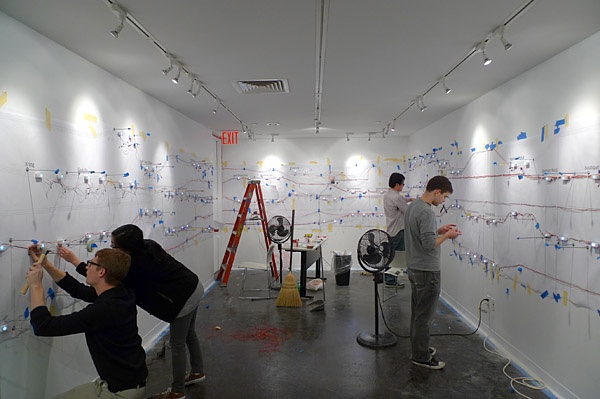
Photo above: Interactive electronics are being installed by Peter Ortner and Juho Lee of SsD who worked long hours over the weekend to install the exhibit. Natalee Newcombe (Program Officer of Contemporary Issues at the Korea Society) and Joe Watson also provided crucial help and coordination in the installation.
19 January 2009
Jinhee Park and John Hong conducted a sustainability workshop at the Universidad Internacional in Quito, Ecuador. The focus was on on locally scaled water management strategies and how these new statial typologies could define urban territories without segregating them.