SsD

architecture + urbanism

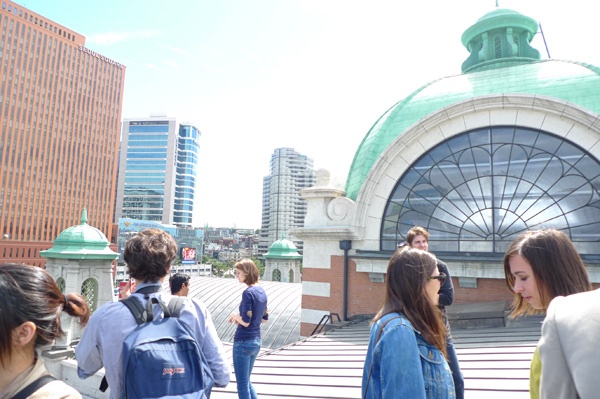
GSD students on roof

We are continuing to explore the theme of 'Light Monumentality' this semester with 12 talented students from the Harvard Graduate School of Design. The site of inquiry is the area surrounding Seoul Station where we have asked students to wrestle with contemporary terms of monumentality in the form of a design proposal for a new international rail station. With the inevitable opening of the border between North and South Korea, a trans-national railway will connect the Asian region with high-speed rail service and eventually future connections will even reach Europe.

Professor and masterplanner Ahn Changmo gave an enlightening tour of the history and future of Seoul Station which culminated at the roof of the historical building.  There we were able to get a panoramic view of the quickly transforming urban surrounds…

‘Light Monumentality’ at SNU

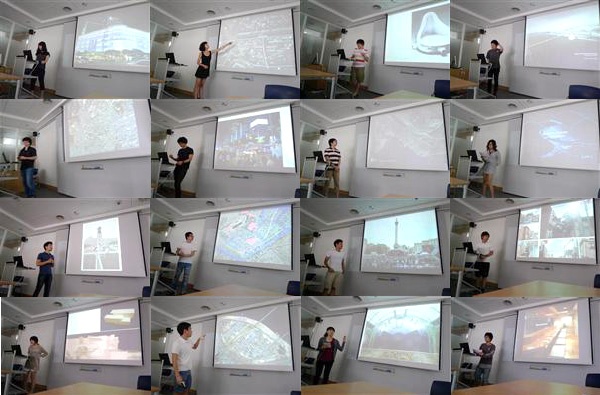
SsD was invited by Seoul National University's Department of Architecture to teach a 5-day workshop for their Frontline series.  We posed the term  'Light Monumentality' to the students, a topic we have been exploring in our recent work.  On the first day, students presented their interpretation of the term.

The workshop brief asks to the students to grapple with concept of monumentality in contemporary architectural terms:  Who or to what power structure does a monument belong?  How does the programmatic function align with its symbolic intent?  Can the social content of the monument shift or does it remain aligned to a single power structure?  We have intentionally juxtaposed the concept of lightness and monumentality to put the terms into question.  We all understand that the monumental assumes a certain gravity, a staid materiality, a relationship to particular ideologies.  However lightness conveys a different conceptual stream: the phenomenological qualities of natural light, lightness of ecological and energy footprints, lightness of contemporary tectonics that can no longer rely upon unlimited human labor, and lightness in terms of the speed of construction required by modern urbanization.

The Korean context is especially a significant backdrop to address these current issues.  With the creation of new urban zones, each of these territories must compete for identity while attempting to generate a sense of publicity within a constantly evolving social and cultural climate.  Architecture then plays a central role as it communicates the larger agendas of these new urban entities.  It is instrumental in communicating the aspirations and the ideas of a larger public sphere.  At the same time it must also be flexible in the context of a quickly transforming society.

SsD lectures at IE University in Spain

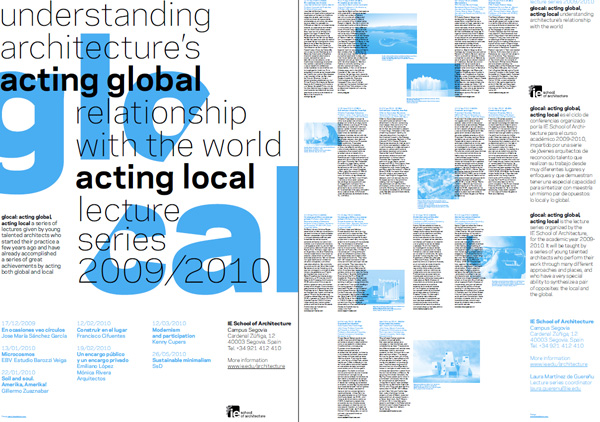
Jinhee Park and John Hong lectured at IE University in Segovia, Spain as the final event in the ‘Acting Local, Acting Global’ series organized by professor Laura Martínez.  A special thanks to Dean Javier Quintana, Associate Dean Jose María Churtichaga, and Martha Thorne for hosting SsD.

The concept of ‘minimalism’ in architecture has taken on more or less superficial applications based on a ‘formal’ reading of the term.  In fact this general and colloquial definition of something that merely appears stripped down has the potential to relegate the idea of the minimal to yet another version of a formalist mannerism.

While we are attempting to expand the idea of minimalism and link it to environmental agendas, a host of related concerns arise.  The word ‘minimum’ has recently made a positive re-debut attaching itself to other terms such as ‘footprint’, ‘material’, ‘energy’, ‘water’, etc.  Our larger question is:  What does all this minimiz-ation add up to? (or subtract down to as the case may be).

Our yet emerging response is that Architecture can contribute to a larger cultural shift  instead of just reacting in opposition to ideas of excess through technical means.  In fact a reactionary stance has the danger of merely solidifying and canonizing the very paradigms that are being contested.  Shifts in the logics of perception, in the understanding of the once autonomous object as now contingent, and in the role of strategic indeterminancy are all topics brought forward by minimalist art and music.  An extension of this cultural production through the medium of sustainability can provide new paradigms for the forward evolution of our patterns (and resultant spaces) of inhabitation.