SsD

architecture + urbanism

Island of Water

Island of Water | Incheon, Korea | 2010
[ international competition shortlist, AIA/BSA Unbuilt Architecture Honor Award ]

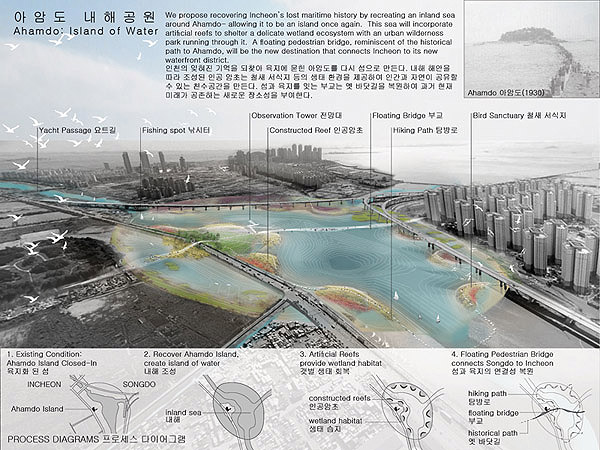
Incheon’s lost maritime history is recovered by recreating an inland sea around the historical Ahamdo island: allowing it to be an island once again. This sea will incorporate artificial reefs to shelter a delicate wetland ecosystem with an urban wilderness park running through it. Recreation areas, visitor's center, and a floating pontoon pedestrian bridge reminiscent of the historical path to Ahamdo are integrated in ways that allow damaged ecosystem to regenerate while simultaneously drawing visitors to witness the gradual change. The landscapes are specifically designed to stabilize and regenerate the marsh while filtering polluting runoff from the adjacent urbanized areas.  Thousands of abandoned boating vessels are re-used to create artificial reefs that control tidal flow allowing the re-creation of the tidal marsh to support local plants and wildlife.  The new pedestrian bridge also doubles as an oyster habitat to filter and replenish the pollutants in the water.


Historic views of Ahamdo Island, circa 1930 (left) – One of Incheon's most significant cultural locations, it was tenuously connected to the land by a footbridge exposed only during low tide. Current conditions of Ahamdo Island show it closed in by infrastructure and infill (right).


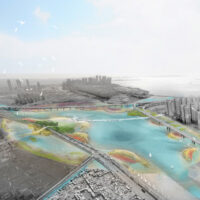
The new varied topography allows for a diversity of plant and wildlife habitats.

Amidst the habitats, a visitor's center lightly touches the ground but allows for extended views.


The floating pontoon bridge made of recycled buoys raises and lowers with the tide without touching the ground. Oyster farms that filter the water are suspended from the understructure.
 

The new pontoon bridge becomes a connective infrastructure between city and waterfront and becomes central viewing area for yearly festivals.


PROJECT CREDITS:

architect
Jinhee Park  AIA + John Hong  AIA, LEED AP (principals in charge), Jiseok Park, Frederick Peter Ortner, Juho Lee


RELATED WORKS:

boston city hall asian cultural complex mass college of art white stadium
emerald km boston city hall acc mass art white stadium

dot_grey

print post print post

Share Button

Braver House completed

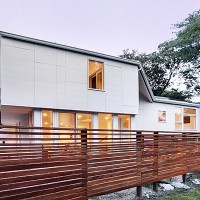
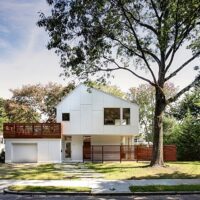
The Braver House  is an alternative for older suburbs where houses are being built to the setback line creating buildings much too big for their lots.  Instead we designed a small footprint house but built a screen to the maximum setback line.  This allows indoor spaces to extend to the exterior and also allows us to drastically reduce potable water use by eliminating a good portion of the suburban grass lawn.
Share Button

Braver House

Newton, MA | 2011
[ Dwell Magazine Feature Feb 2012 ]

In many older suburbs, the typical pattern of construction is to replace an existing house with a much larger one built out to the legal setbacks. The Braver House is a prototypical alternative: To instead build a small, efficient residence that simultaneously minimizes its actual footprint, while maximizing its perceived sense of interior space. This is achieved through two methods: By expanding a diaphanous screen to the setback line expanding the territory of the interior to the exterior, and by shifting the plan and section to capture elongated views from inside to outside. By claiming the under utilized lawn of the typical suburban yard and replacing it with permeable hardscape, potable water use is drastically reduced. In terms of minimizing energy use, the diminutive size of the house is coupled with a completely passive cooling system, a solar powered radiant heated floor and super insulated walls and roof.


Minimum Footprint / Maximum Permeability In older suburbs where landcost has multiplied, new rebuilds are typically built out to the legal setback line. The Braver House proposes a new minimum footprint solution where the sense of space is expanded by instead building a screen out to the setback line. If deployed as a prototype, a series of Braver Houses could increase the permeability of a catchment area decreasing the burden on municipal systems. Meanwhile energy use would be drastically reduced due to the smaller size.


Interior spaces are overlapped with the exterior: the wooden screen becomes a middle ground that defines expanded boundaries. In the living area (top), a high efficiency, low-emission wood burning stove supplements the solar powered radiant floor heating system. Its proximity to the passive stack directly opposite from it allows heat to be drawn into the upper floors of the house.  A renewable cork floor is used throughout the house. Its color is matched with the exterior screen to create visual and spatial continuity.


1st Floor Plan: Each interior space has a reciprocal exterior space – for instance the living and dining areas have their counterpart directly opposite a set of floor to ceiling windows so that the landscape screen becomes the the 'outside' rather than the envelope of the house.

View of sideyard: The openness of the ground floor is screened from neighbors while cantilevered 2nd floor areas provide shading for the ground floor. The strategically asymmetrical pitch of the roof conceals an array of solar panels while maximizing their solar exposure.
 

Beginning with the existing site slope, the house is shifted in both plan and section: Although the rooms are small, oblique views expand the sense of space.

Instead of foreshortened frontal views, the shift in plan extends views obliquely through the sideyard.
 

The shift in plan and section extends views through the public areas of the house and to the yard beyond.

Second Floor Plan (left): The spaces are organized around a vertical ventilation and plumbing core.  The gently sloping stair (right) creates a vertical continuity between the elements of the house.

The stair wraps around the infrastructural core and becomes a protagonist as it moves through the house organizing adjacent spaces and views to the outside (top and left). From the master bedroom (right) the interior of the stair becomes an ‘exterior.’


At the core of the house, a passive stack vents warm air through an operable skylight and brings daylight into the building's center.  The natural flow of air eliminates the need for mechanical air conditioning
 
 
The combination of the screens and overall massing allow the project to read not as a single structure, but as a pair of smaller pavilions with landscape in between. Replacing the yard within the screens with permeable hardscape drastically reduces the use of potable water while maintaining the decreased area of grass outside the screen allows the project to 'blend in' with its neighbors.


PROJECT CREDITS:

architect
John Hong  AIA, LEED + Jinhee Park  AIA  (principals in charge), Matthew Allen, Frederick Peter Ortner, Christoph Schäfer, Aleta Budd, Brian Vester, Nathalie Zegarra

construction manager
Osprey Design/Build LLC

structural engineer
Evan Hankin


RELATED WORKS:

8 towers coulter house hbny verdant studios
8 towers hidden house coulter house hbny verdant studios

dot_grey

print post print post


Share Button

SsD is selected as a finalist in the Incheon City Design Competition

SsD has been selected as a finalist in an international competition in Incheon, Korea. We propose recovering Incheon's lost maritime history by recreating an inland sea around its Ahamdo island - now threatened to be infilled by adjacent urban development – allowing it to be an island once again. This sea will incorporate artificial reefs to shelter a delicate wetland ecosystem with an urban wilderness park running through it. A floating pedestrian bridge, reminiscent of the historical path to Ahamdo, will be the new destination that connects Incheon to its new waterfront district.

Share Button

Hydrotowers

Panama City, Panama | 2008 

As Panama City expands at an unprecedented rate, environmental sustainability is becoming central to future developments. However, because of the high amount of rainfall and humidity, the effect of natural ventilation strategies for office and residential towers is limited. Instead we looked at ways to both generate electricity and harvest rainwater through a series of architectural ‘waterfalls’: Rainwater falling on the tower roofs is brought down to the lower roof of the tower base where gentle sloping surfaces generated from parking and pedestrian circulation is used to create a series of ‘waterfalls’ that turn a series electricity generating turbines. The water is then filtered and stored to water the sloping green roofs during dry, hot months.
 

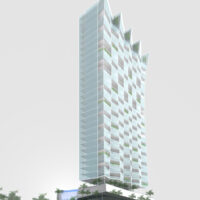
  Through the variation of the skin many differentiations are created in unit types and sizes without changing the essential layout of the building infrastructure.  Views orientations are multiplied and where the skin is flat, 2-story duplex units are formed.


Aerial view of Type 2 towers: Several hundred meters east of the Type 1 towers, the base of these mixed-use buildings is similar to the Type 1 tower so that they are understood as part of the same green infrastructural network.  The mixed commercial and residential program is split by a community center and indoor pool that spans both towers.


dot_grey
PROJECT CREDITS:

architect
John Hong AIA/LEED, Jinhee Park AIA  (principals in charge), Catarina Marques


RELATED PROJECTS:

asian cultural complex 8 towers white stadium soft lofts  
acc 8 towers white stadium soft lofts  

dot_grey


print post print post
Share Button

Emerald Kilometer

Thu Thiem, Vietnam | 2008

The proposed plaza, park, and bridge hosts ceremonial and everyday events in a new mixed-use district for Ho Chi Minh City in Vietnam. Our project creates a kilometer long plaza, green in its physical presence, green in its construction and dynamically scalable to the events of the city. Floating above the entire plaza and bridge is a monumental pergola, a filigree of steel cables covered in flowering vines, the patterns of the openings creating an ever changing play of shadow and light. This unifying roof turns the plaza into a single super-scaled outdoor living room. At the same time, a panoply of differently scaled openings create a series of perceptual spaces of different sizes, intimate at the lake end and becoming progressively more grand as they approach the Saigon River.


Comparison of Plaza Sizes:A network of paths and spaces defined by the landscape canopy extends over the river and creates the perception of a lengthened plaza that connects the two sections of the city.

As well as providing shade for the plaza, the urban scale canopy defines a multitude of programmatic activities and scales to animate the space around the clock.


The canopy and paving work in conjunction as a new infrastructure:  Both overhead photo-voltaics in the canopy and under-foot Piezo-electric flooring generates energy which then powers the lighting and public wi-fi installed in the canopy.  Runoff water collected from the permeable paving is filtered and re-used for public restrooms and to drip irrigate the canopy vines.

dot_grey
PROJECT CREDITS:

architect
Jinhee Park AIA + John Hong AIA, LEED (principals in charge), Jonathan Louie, Matthew Allen, Frederick Peter Ortner, Brett Albert, Daniel Cashen

landscape architect
Ground, Inc.


RELATED PROJECTS:

boston city hall mass college of art      
boston city hall mass art      

dot_grey
 

print post print post
Share Button

White Stadium

Seoul, Korea | 2008
[finalist, invited competition]

white stadium sdo

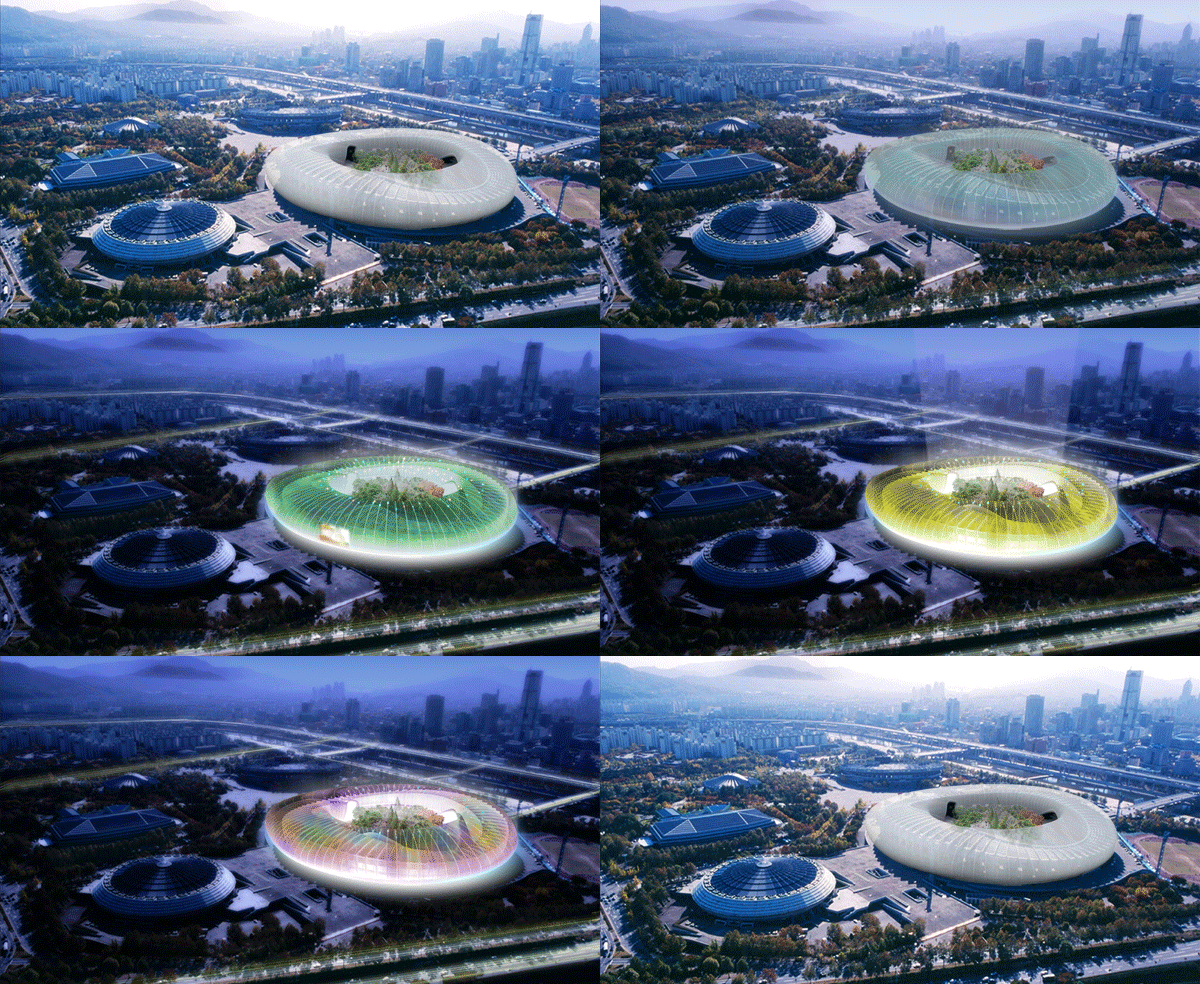
Water, digital technology, and sustainability are merged in this new reinterpretation of the iconic but now underutilized Seoul Olympic Stadium.  A temporary structure to house the international Seoul Design Olympiad (SDO) events, an inflatable arch is held away from the structure of the historic stadium.  Through a simple process of condensing water on the surface of this inflatable structure through solar evaporation, rain runoff is purified and ‘misted’ to create a white volume that catches digital light and defines new energized events.  The mist also nourishes a nursery of culturally significant trees within the center of the stadium.  At the end of the event, these trees are placed throughout the city of Seoul according to the city’s masterplan, extending the positive memory of the white stadium.


sdo baekja

Inspired by the simple and elegant pottery of the Baek-Ja era, the stadium becomes a new urban figure.  By using an inflatable structure combined with a simple process of condensing water in sunlight within the inflatable,  the mist at times hides the stadium and then allows it to reappear giving the existing building a new sense of life.

white stadium section
As the stadium fronts the Hangang River, contaminated water from the river is purified through the condensation process and used to water a grove of trees.

The simple process of purifying water through condensation is demonstrated.

white stadium trees

The nursery of trees is then relocated to different parts of Seoul according to the city's masterplan.  The alliance of the two major municipal projects creates an overall savings for the city.

white stadium detail

The  purified water is used for irrigation as well as well as for creating atmospheric mists for events.

white stadium  waterfront

View from the Han River: Changing patterns of white mist illuminated by LED's define the underutilized existing stadium as a new event space.  The purification of the water into mist allows the public to understand the importance of the river.


PROJECT CREDITS:

architect
Jinhee Park  AIA + John Hong  AIA, LEED (principals in charge), Frederick Peter Ortner, Chris Ryan, Leehong Kim, Jaeyoon Kim, Chang Zhang

structural engineer
Paul Kassabian, SGH


RELATED PROJECTS:

asian cultural complex czech library boston harbor pavilion cade museum  
acc czech library boston harbor cade museum  

dot_grey
< back to:   works cultural


print post print post

Share Button