SsD

architecture + urbanism

White Block ‘Supercore’ Completed

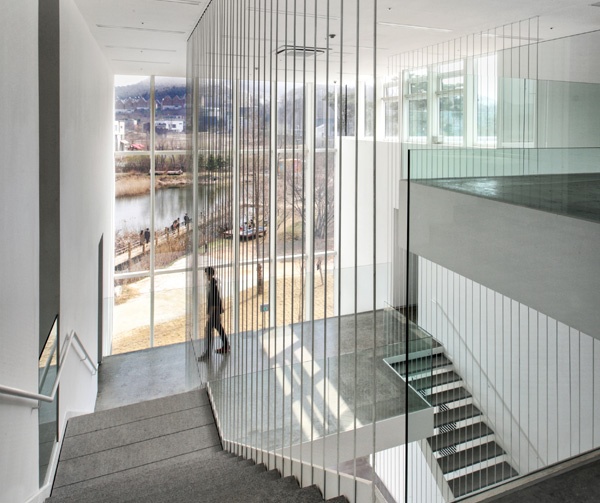
The stairs and railing of the ‘super core’ have been installed at White Block. This main vertical core of the building allows the varied gallery spaces a sense of interior intensity while simultaneously linking them to the exterior topographic condition.  As one progressively moves through a series of volumes, one is reoriented toward the immediate environment.

As all the galleries are adjacent to this core, motorized vents allow a constant flow of air, passively ventilating the entire building.

Braver House completed

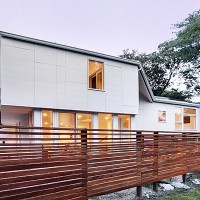
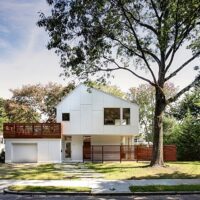
The Braver House  is an alternative for older suburbs where houses are being built to the setback line creating buildings much too big for their lots.  Instead we designed a small footprint house but built a screen to the maximum setback line.  This allows indoor spaces to extend to the exterior and also allows us to drastically reduce potable water use by eliminating a good portion of the suburban grass lawn.

Braver House

Newton, MA | 2011
[ Dwell Magazine Feature Feb 2012 ]

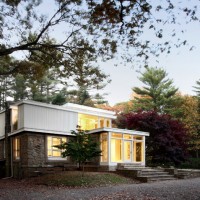
In many older suburbs, the typical pattern of construction is to replace an existing house with a much larger one built out to the legal setbacks. The Braver House is a prototypical alternative: To instead build a small, efficient residence that simultaneously minimizes its actual footprint, while maximizing its perceived sense of interior space. This is achieved through two methods: By expanding a diaphanous screen to the setback line expanding the territory of the interior to the exterior, and by shifting the plan and section to capture elongated views from inside to outside. By claiming the under utilized lawn of the typical suburban yard and replacing it with permeable hardscape, potable water use is drastically reduced. In terms of minimizing energy use, the diminutive size of the house is coupled with a completely passive cooling system, a solar powered radiant heated floor and super insulated walls and roof.

Minimum Footprint / Maximum Permeability In older suburbs where landcost has multiplied, new rebuilds are typically built out to the legal setback line. The Braver House proposes a new minimum footprint solution where the sense of space is expanded by instead building a screen out to the setback line. If deployed as a prototype, a series of Braver Houses could increase the permeability of a catchment area decreasing the burden on municipal systems. Meanwhile energy use would be drastically reduced due to the smaller size.


Interior spaces are overlapped with the exterior: the wooden screen becomes a middle ground that defines expanded boundaries. In the living area (top), a high efficiency, low-emission wood burning stove supplements the solar powered radiant floor heating system. Its proximity to the passive stack directly opposite from it allows heat to be drawn into the upper floors of the house.  A renewable cork floor is used throughout the house. Its color is matched with the exterior screen to create visual and spatial continuity.


1st Floor Plan: Each interior space has a reciprocal exterior space – for instance the living and dining areas have their counterpart directly opposite a set of floor to ceiling windows so that the landscape screen becomes the the 'outside' rather than the envelope of the house.

View of sideyard: The openness of the ground floor is screened from neighbors while cantilevered 2nd floor areas provide shading for the ground floor. The strategically asymmetrical pitch of the roof conceals an array of solar panels while maximizing their solar exposure.
 

Beginning with the existing site slope, the house is shifted in both plan and section: Although the rooms are small, oblique views expand the sense of space.

Instead of foreshortened frontal views, the shift in plan extends views obliquely through the sideyard.
 

The shift in plan and section extends views through the public areas of the house and to the yard beyond.

Second Floor Plan (left): The spaces are organized around a vertical ventilation and plumbing core.  The gently sloping stair (right) creates a vertical continuity between the elements of the house.

The stair wraps around the infrastructural core and becomes a protagonist as it moves through the house organizing adjacent spaces and views to the outside (top and left). From the master bedroom (right) the interior of the stair becomes an ‘exterior.’


At the core of the house, a passive stack vents warm air through an operable skylight and brings daylight into the building's center.  The natural flow of air eliminates the need for mechanical air conditioning
 
 
The combination of the screens and overall massing allow the project to read not as a single structure, but as a pair of smaller pavilions with landscape in between. Replacing the yard within the screens with permeable hardscape drastically reduces the use of potable water while maintaining the decreased area of grass outside the screen allows the project to 'blend in' with its neighbors.


PROJECT CREDITS:

architect
John Hong  AIA, LEED + Jinhee Park  AIA  (principals in charge), Matthew Allen, Frederick Peter Ortner, Christoph Schäfer, Aleta Budd, Brian Vester, Nathalie Zegarra

construction manager
Osprey Design/Build LLC

structural engineer
Evan Hankin


RELATED WORKS:

8 towers coulter house hbny verdant studios
8 towers hidden house coulter house hbny verdant studios

dot_grey

print post print post


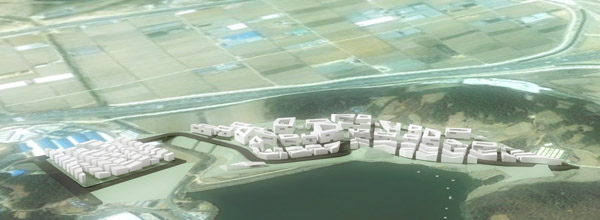
SsD teams with Parkkim and Jegong Architects: wins 2nd place in major urban design competition

SsD focused on sustainable low-rise / high-density urbanism for this new waterfront city south of Seoul.  Although the design of the new urban parcels are strategically individualzed and limited in scale, as a whole they work in conjunction with each other in contributing to an overall energy and resource strategy:  By working as a single entity rather than a fragmented whole,  solar energy is harnessed, water runoff controlled, prevailing winds captured for passive cooling, and public space aggregated into a larger cohesive network that links surrounding topographies.

In keeping with this theme that the ’whole is greater than the sum of its parts,’ the 2nd place win against four of the largest firms in Korea is  ’partial confirmation’ that a collaborative of smaller firms can form a strong interdisciplinary team able to compete on an international level.

Verdant Studios

Athens, VT | 2006
[featured in Spacecraft 2]

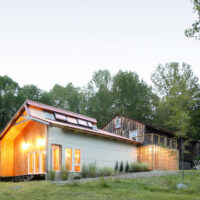
This recording studio for prominent recording engineer and musician Pete Weiss, solves specific issues of acoustics while engaging the site and context. An extension of an existing century-old barn, the new structure utilizes a transformation of the pitched roofs in the area: a simple 'scissor' truss is mirrored to create both east and west skylights while on the interior, the asymmetrical space allows for a positive scattering of sound. The open end-bay of the structure telescopes views into the rural landscape and creates a rest area for musicians.

verdant studios
 

verdant roof
 

verdant scissor roof

A prefabricated  scissor truss is repeated and mirrored to allow for constant illumination throughout the day.
 

verdant porch

An inset front wall creates a porch-like space for musicians to take breaks within the verdant landscape.  The roof forms echo the existing house on the site.

verdant context

The project takes a deferential role to the larger natural context.

PROJECT CREDITS:

architect
John Hong AIA,LEED,  Jinhee Park AIA (principals in charge), Andy Hong, Erik Carlson

contractor
Don Clark Construction


RELATED WORKS:

1948 house coulter house  
1948 house hidden house coulter house braver house  

dot_grey

print post print post

Coulter House

Medfield, MA | 2008

This addition above an existing structure expands the experience of the house without physically making it bigger.  The ‘interior-ness’ of the existing stone ground level is juxtaposed against the ‘exterior-ness’ of the new second level:  The light-weight and light-filled spaces of the new second floor are separated into 3 separate pavilions.  This fragmentation allows framed views to the surrounding landscape and new captured roof-gardens that both connect and separate the rooms.  Through energy efficient passive techniques including stack ventilation and the strategic use of overhangs, the need for mechanical summer cooling is eliminated.  In the winter the low-winter sun is harnessed to heat the thermally massive floor.
 

coulter-existing

A new second story (photo above) replaced the original dilapidated one (photo below).  A new entry porch was added to unify the new and original architectures.


coulter diagram

Instead of increasing the size of the house, the new upper level is conceived of as 3 pavilions (right).  The new spatial seams between the volumes  expand the experience of the spaces creating a dynamic spatial contrast with the inward looking existing ground floor spaces (left).
 

coulter seams --

coulter bamboo garden

The space between the pavilions becomes a captured bamboo courtyard.


3 pavilions

3 pavilions: The concept diagram shows how dividing the program into 3 pavilions allows the house to stay small while extending the sense of space from inside to outside.

coulter passive solar

Passive solar techniques: A roof overhang blocks high summer sun while allowing low winter sun keeping the thermally massive floor cool in the summer and hot in the winter.

coulter living before-after

A strategic cut in the ceiling connects the existing ground floor with the new 2nd floor (left).  Natural light and ventilation is now brought into a space that was originally dark and required artificial lighting even during the day (right).
 

coulter double height

The double height space stack ventilates the house bringing cool air from below and releasing hot air through upper level clerestory windows.  The passive cooling techinique eliminates the need for air conditioning.

dot_grey

PROJECT CREDITS:-

architect
Jinhee Park AIA (principal in charge), John Hong AIA/LEED (collaborating principal), Anne Levallois, Erik Carlson, Jiseok Park, Ann Ha

structural engineer
Tripi Engineering Services, LLC

contractor
Oteri Construction

fabrication
Osprey Design/Build


RELATED PROJECTS:

hbny 8 towers 1948 house    

dot_grey


print post print post