SsD

architecture + urbanism

The Center for Arts at the Armory is completed

In terms of preservation strategies, armories are truly a difficult urban building type.  Once a place for military training, they are now becoming almost wholly obsolete:  Their vast interior drill hall and their monumental footprint makes them difficult to convert to any other urban program including housing.  Meanwhile, many of them appear on highly restrictive state or national historic registers.  This confounds developers further as surrounding land costs and thus development intensity has multiplied around these buildings but the restrictions placed on renovating them makes it impossible to increase their density and make the numbers work.

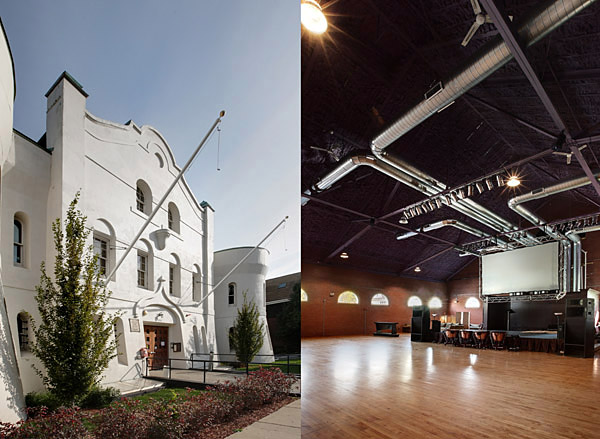
The Somerville Armory is one such building.  Nestled in an otherwise dense residential zone, it sat underutilized for years, slowly deteriorating.  After the building was courageously acquired by the Highland Avenue Trust, we worked with them, the Arts at the Armory, the City of Somerville, and the Massachusetts State Historical Commission to adaptively re-use the structure into a  regional, 30,000 sf non-profit arts center that houses a multitude of community oriented programs including NGO's, artists, dance, and music studios and offices, galleries, arts education and after school programs, and a cafe/performance space.  The building's anchor is the former drill hall which now serves as a multi-use space that host a variety of community programs, concerts, and educational venues.

Share Button

Hidden Fortune House

Cambridge, MA | 2010

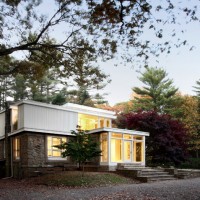
The Hidden Fortune House is a a 350 square foot addition to an existing historical residence. The project’s diminutive size is deceptive: Placed between the interior collective areas of the existing house and the exterior garden, it is conceived of as not an autonomous object, but as an extended frame that forms new spatial connections and continuities. Its folded zinc clad shape (likened to a fortune cookie) negotiates the goal of creating a light and lofty space with the reality of restrictive zoning processes.  Built-in shelving increases the efficiency and flexibility of the space dramatically while making the storage appear compact and part of the interior walls. Innovatively pushing the geometric limits of prefabricated SIP panels, a nuanced geometry (rather than the default box-like form of pre-fab architecture) extends views, shades afternoon sun, and mediates scale differences within the urban context.


The window wall in relationship to the profile of the roof and ceiling allows the view to expand toward the garden and the sky.

Although the new family room is small, it is designed as the connecting space to the other public areas of the house extending views outside to the garden.  The profile of the ceiling as it meets the window wall increases the amount of natural light without adding to glare while also providing a sense of spatial extension beyond the height of the ceiling.  Like the building frame itself, the shelving system is a series of modular boxes, with and without cabinet doors, that can be configured in various ways.

A half level down from the existing public areas of the house, the new addition connects the garden with the kitchen.  The stair then occupies the zone of the folded ceiling to connect a path to the outside using natural light as a cue (left).  A skylight brings light into the kitchen (right) while framing an extended view to the sky.  A perforated aluminum balcony screens one space from the other while also allowing visual continuity.


PROJECT CREDITS:

architect
John Hong AIA, LEED + Jinhee Park AIA (principals in charge), Frederick Peter Ortner, Trevor Patt, Stephen Fan

construction manager
Osprey Design/Build LLC
 

RELATED PROJECTS:

coulter house verdant studios  
coulter house infinite box verdant studios braver house  

dot_grey
 

print post print post
Share Button

White Stadium

Seoul, Korea | 2008
[finalist, invited competition]

white stadium sdo

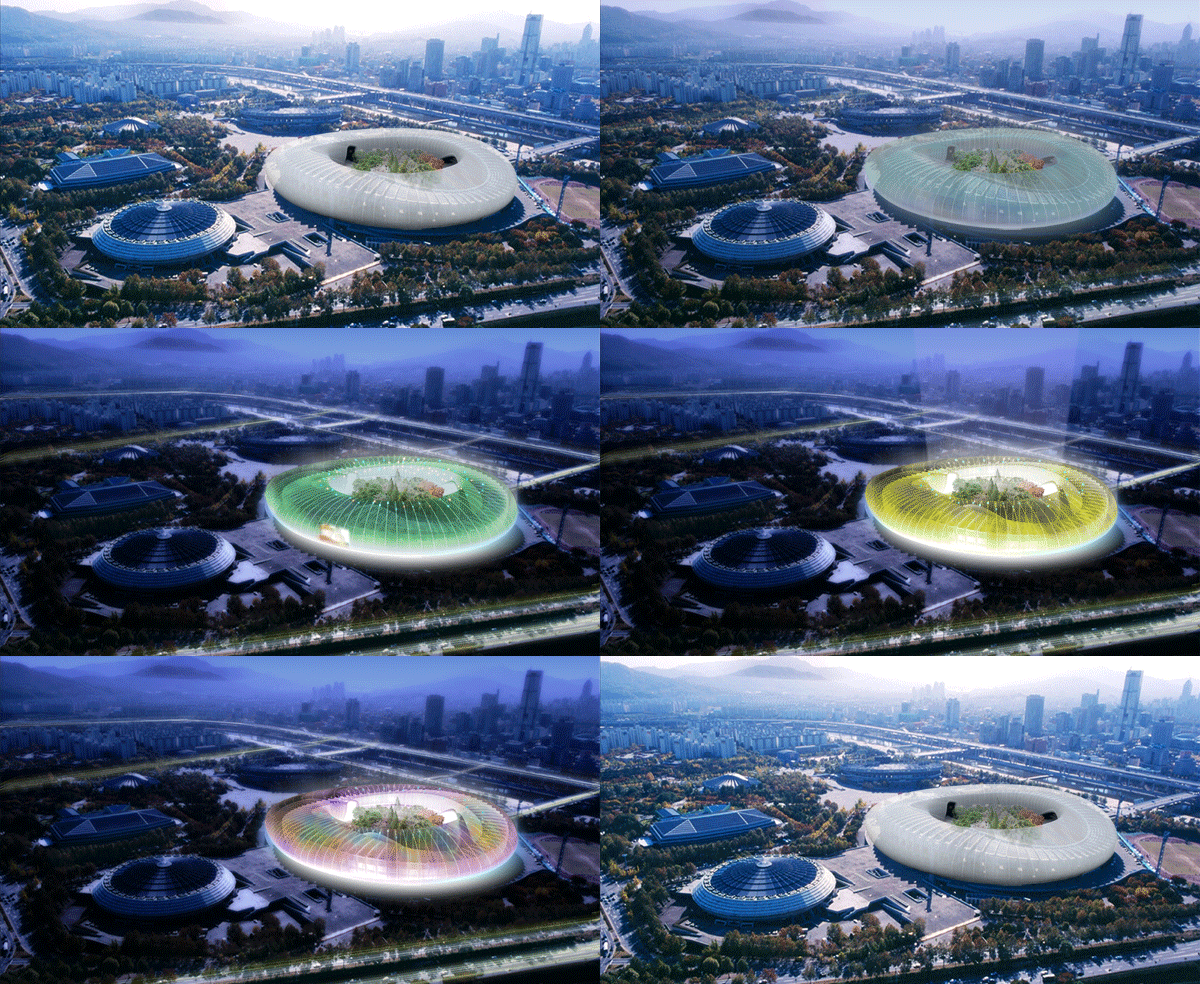
Water, digital technology, and sustainability are merged in this new reinterpretation of the iconic but now underutilized Seoul Olympic Stadium.  A temporary structure to house the international Seoul Design Olympiad (SDO) events, an inflatable arch is held away from the structure of the historic stadium.  Through a simple process of condensing water on the surface of this inflatable structure through solar evaporation, rain runoff is purified and ‘misted’ to create a white volume that catches digital light and defines new energized events.  The mist also nourishes a nursery of culturally significant trees within the center of the stadium.  At the end of the event, these trees are placed throughout the city of Seoul according to the city’s masterplan, extending the positive memory of the white stadium.


sdo baekja

Inspired by the simple and elegant pottery of the Baek-Ja era, the stadium becomes a new urban figure.  By using an inflatable structure combined with a simple process of condensing water in sunlight within the inflatable,  the mist at times hides the stadium and then allows it to reappear giving the existing building a new sense of life.

white stadium section
As the stadium fronts the Hangang River, contaminated water from the river is purified through the condensation process and used to water a grove of trees.

The simple process of purifying water through condensation is demonstrated.

white stadium trees

The nursery of trees is then relocated to different parts of Seoul according to the city's masterplan.  The alliance of the two major municipal projects creates an overall savings for the city.

white stadium detail

The  purified water is used for irrigation as well as well as for creating atmospheric mists for events.

white stadium  waterfront

View from the Han River: Changing patterns of white mist illuminated by LED's define the underutilized existing stadium as a new event space.  The purification of the water into mist allows the public to understand the importance of the river.


PROJECT CREDITS:

architect
Jinhee Park  AIA + John Hong  AIA, LEED (principals in charge), Frederick Peter Ortner, Chris Ryan, Leehong Kim, Jaeyoon Kim, Chang Zhang

structural engineer
Paul Kassabian, SGH


RELATED PROJECTS:

asian cultural complex czech library boston harbor pavilion cade museum  
acc czech library boston harbor cade museum  

dot_grey
< back to:   works cultural


print post print post

Share Button

Verdant Studios

Athens, VT | 2006
[featured in Spacecraft 2]

verdant studios

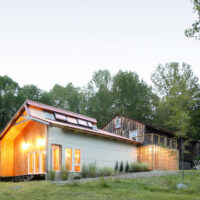
This recording studio for prominent recording engineer and musician Pete Weiss, solves specific issues of acoustics while engaging the site and context. An extension of an existing century-old barn, the new structure utilizes a transformation of the pitched roofs in the area: a simple 'scissor' truss is mirrored to create both east and west skylights while on the interior, the asymmetrical space allows for a positive scattering of sound. The open end-bay of the structure telescopes views into the rural landscape and creates a rest area for musicians.


verdant roof
 

verdant scissor roof

A prefabricated  scissor truss is repeated and mirrored to allow for constant illumination throughout the day.
 

verdant porch

An inset front wall creates a porch-like space for musicians to take breaks within the verdant landscape.  The roof forms echo the existing house on the site.

verdant context

The project takes a deferential role to the larger natural context.

PROJECT CREDITS:

architect
John Hong AIA,LEED,  Jinhee Park AIA (principals in charge), Andy Hong, Erik Carlson

contractor
Don Clark Construction


RELATED WORKS:

1948 house coulter house  
1948 house hidden house coulter house braver house  

dot_grey

print post print post
Share Button

Coulter House

Medfield, MA | 2008

This addition above an existing structure expands the experience of the house without physically making it bigger.  The ‘interior-ness’ of the existing stone ground level is juxtaposed against the ‘exterior-ness’ of the new second level:  The light-weight and light-filled spaces of the new second floor are separated into 3 separate pavilions.  This fragmentation allows framed views to the surrounding landscape and new captured roof-gardens that both connect and separate the rooms.  Through energy efficient passive techniques including stack ventilation and the strategic use of overhangs, the need for mechanical summer cooling is eliminated.  In the winter the low-winter sun is harnessed to heat the thermally massive floor.
 

coulter-existing

A new second story (photo above) replaced the original dilapidated one (photo below).  A new entry porch was added to unify the new and original architectures.


coulter diagram

Instead of increasing the size of the house, the new upper level is conceived of as 3 pavilions (right).  The new spatial seams between the volumes  expand the experience of the spaces creating a dynamic spatial contrast with the inward looking existing ground floor spaces (left).
 

coulter seams --

coulter bamboo garden

The space between the pavilions becomes a captured bamboo courtyard.


3 pavilions

3 pavilions: The concept diagram shows how dividing the program into 3 pavilions allows the house to stay small while extending the sense of space from inside to outside.

coulter passive solar

Passive solar techniques: A roof overhang blocks high summer sun while allowing low winter sun keeping the thermally massive floor cool in the summer and hot in the winter.

coulter living before-after

A strategic cut in the ceiling connects the existing ground floor with the new 2nd floor (left).  Natural light and ventilation is now brought into a space that was originally dark and required artificial lighting even during the day (right).
 

coulter double height

The double height space stack ventilates the house bringing cool air from below and releasing hot air through upper level clerestory windows.  The passive cooling techinique eliminates the need for air conditioning.

dot_grey

PROJECT CREDITS:-

architect
Jinhee Park AIA (principal in charge), John Hong AIA/LEED (collaborating principal), Anne Levallois, Erik Carlson, Jiseok Park, Ann Ha

structural engineer
Tripi Engineering Services, LLC

contractor
Oteri Construction

fabrication
Osprey Design/Build


RELATED PROJECTS:

hbny 8 towers 1948 house    

dot_grey


print post print post
Share Button