SsD

architecture + urbanism

New Asian City Roundtable at Van Alen

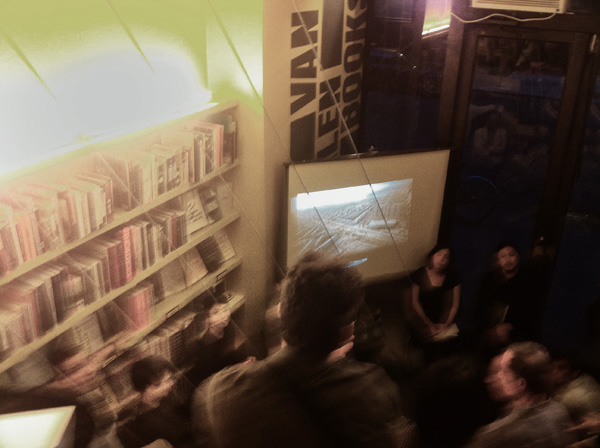
It was a privilege moderating a discussion on Jini Kim Watson's The New Asian City at Van Alen Books. The event was organized by Natalee Newcombe of the Korea Society and included panelists Andrei Harwell (Yale University), Samuel Jamier (Japan Society), Jini Kim Watson (NYU), and Jinhee Park and John Hong (SsD / Harvard). The conversation was organized around the 5 themes defined in Jinhee and John's upcoming book Convergent Flux Korea, which include topographical syntax, historical transformation, accelerated density, material identity, infrastructural alliance.

Each panelist took on the interrelationship between several themes: Jini started off by speaking about how infrastructural alliances and historical transformations disrupted the physical and psychic notions of urban space in Korea. Andrei presented the themes of historical transformation and accelerated density using the example of Shanghai's creative industry clusters as an alternative to wholesale tabula rasa urban renewal. Samuel looked at ideas of material identity and  topographical syntax drawing Deleuzian 'lines of flight' that connected and contrasted cultural conceptions of territory in Korean, Japanese, and Chinese contemporary cinema. Jinhee and John's moderation brought into focus Jini's ideas of power relationships covered in her book:  How the transplanting of culture from colony to colonizer enables new understandings of both domestic and metropolitan space.

The evening ended with questions from the audience: Harvard GSD student Gabe Tomasulo asked the pointed question of whether some of these new conditions of the Asian City, which at first glance are seen as 'negative' or compromised from the Western gaze, can actually instead become new points of design inquiry. Jinhee answered that in fact there are current examples in Korea where architects are using the extreme density and typological contortions that density creates as launching points for new forms of social space.  [photo courtesy Mark Pomarico]

Share Button

Monumental Final Review at Harvard GSD

At the final review at the Harvard GSD, we explored the question of 'Light Monumentality,' this time more in depth: How can we address monumentality in contemporary terms when societal, material, and urban forces are in flux? Can the monumental be separated from the monument? What is the intersection of the sublime, the ultra-natural, and the urban environment?

Our stellar GSD students presented: Mark Pomarico, Andreas Thuy, Bosuk Hur, Isabelle Nutzi, Victor Amado, Vera Baranova, Hernan Garcia, Fareez Giga, Kyung Ho Won, Arielle Assouline-Lichten, and Glen Santayana Jr. The engaged jury consisted of Shih-Fu Peng, Timothy Hyde, David Salomon, George Legendre, Wang Shu, Yael Erel, Robert Campbell, Lluis Ortega, Richard Peiser, and Ana Heringer, with a special visit from our sponsors from Seoul's Samoo office, Gigson Rhie and Donghoon Kim.

Share Button

Light Monumentality Final at SNU

SNU students presented their final images for the 5-day 'Light Monumentality' workshop. Rather than the students initially explaining their intentions, in a pedagogical reversal we asked the critics to respond first by only reading into a single large scale image produced by each of the students. SNU Professors Kim Seung Hoy, Kim Jin Kyoon, Peter Ferretto, along with Prof. Choe Sangki from University of Seoul, and Park Yoonjin from Parkkim, quickly adjusted to the new situation, insightfully critiquing (and sometimes productively misreading) the student's intentions. Only afterwards were the students allowed to present additional drawings and verbally respond.

The reversed exercise was not only a lot of fun for all participants, it also reflected one of the key concepts of the workshop: That in monumental architecture, the image many times precedes the specifics of the architectural resolution: The concepts of the image, whether fabricated or real, inevitably become merged and conflated with the actualities of the architectural form to the point that the reality of the space is only fully understood through its image.

Share Button

SsD at Modern Atlanta

SsD's video 'Bicycle Ride' is an animated survey of our recent work and is on exhibit at the Modern Atlanta Museum.  A special thanks to Manifesto Architecture who curated and designed the exhibit.  Also thanks to the 'inep+ 93nii' at xarrier for creating the original music – more collaborations with them in the near future…

The idea that architecture is beyond what can be represented in still images has haunted our recent work.  We have recently explored animation as a means to describe the passage of time: the changes brought on by people inhabiting the spaces, the impact of natural elements, the idea of process. But the question remains -  how does one communicate  transformation, experience, and phenomenon, in a globalizing economy where the exchange value of pure imagery remains a driving force?  In fact, even with the promise of the internet and 'multi-media,' the iconic still-frame still drives (and limits) how architecture is represented – perhaps even more so today.  Our own work however is moving from three dimensions to incorporating the fourth dimension of time:  How can the sequence of moving through the spaces be part of the everyday existense of the building? How can the architecture itself be abstract enough, not for abstraction's sake, but in the service of allowing multiple readings and uses? Instead of a series of still images, perhaps our portfolio should become a flip-book.

Share Button