Posts Tagged ‘sustainable’

White Stadium

Saturday, September 12th, 2009

Seoul, Korea | 2008
[finalist, invited competition]

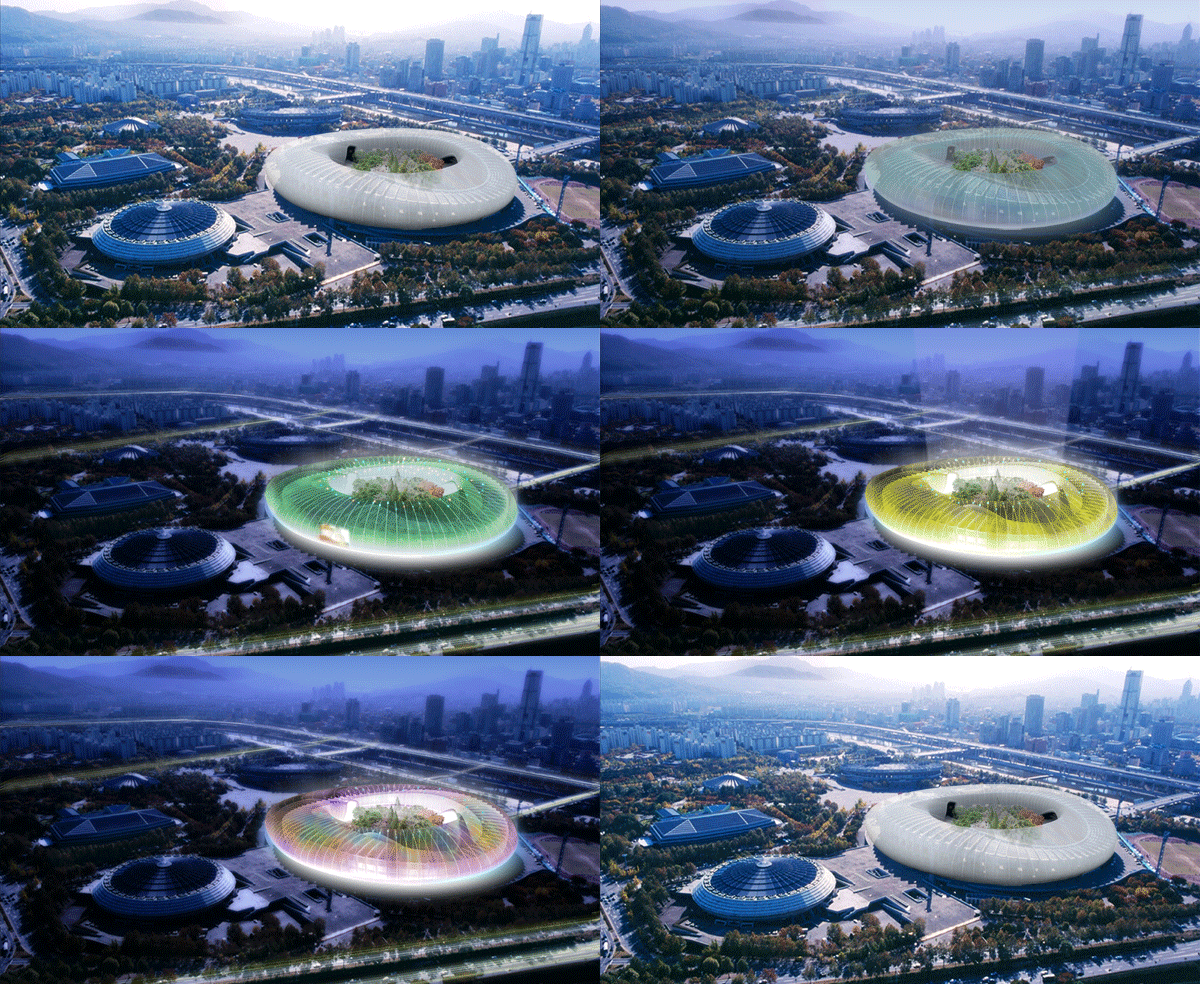
Water, digital technology, and sustainability are merged in this new reinterpretation of the iconic but now underutilized Seoul Olympic Stadium.  A temporary structure to house the international Seoul Design Olympiad (SDO) events, an inflatable arch is held away from the structure of the historic stadium.  Through a simple process of condensing water on the surface of this inflatable structure through solar evaporation, rain runoff is purified and ‘misted’ to create a white volume that catches digital light and defines new energized events.  The mist also nourishes a nursery of culturally significant trees within the center of the stadium.  At the end of the event, these trees are placed throughout the city of Seoul according to the city’s masterplan, extending the positive memory of the white stadium.

white stadium sdo

During the day, the inflatable structure becomes a white symbolic volume.  Sunlight is used to condense and purify water which is used to feed the garden as well as create mist. At night, LED lighting and large scale projections allow the space to become a festive center for events.  The use of mist from water purified during the day enhances the effects of the lighting.


sdo baekja

Inspired by the simple and elegant pottery of the Baek-Ja era, the stadium becomes a new urban figure.  By using an inflatable structure combined with a simple process of condensing water in sunlight within the inflatable,  the mist at times hides the stadium and then allows it to reappear giving the existing building a new sense of life.

white stadium section
As the stadium fronts the Hangang River, contaminated water from the river is purified through the condensation process and used to water a grove of trees.

water purify

The simple process of purifying water through condensation is demonstrated.

white stadium trees

The nursery of trees is then relocated to different parts of Seoul according to the city’s masterplan.  The alliance of the two major municipal projects creates an overall savings for the city.


white stadium detail

The  purified water is used for irrigation as well as well as for creating atmospheric mists for events.

white stadium  waterfront

View from the Han River: Changing patterns of white mist illuminated by LED’s define the underutilized existing stadium as a new event space.  The purification of the water into mist allows the public to understand the importance of the river.


PROJECT CREDITS:

architect
Jinhee Park  AIA (principal in charge), John Hong  AIA, LEED (collaborating principal), Frederick Peter Ortner, Chris Ryan, Leehong Kim, Jaeyoon Kim

structural engineer
Paul Kassabian, SGH


RELATED PROJECTS:

providence plaza  czech library boston harbor pavilion asian cultural complex  
prov plaza czech library boston harbor acc


dot_grey
index <  works cultural


print post print post


Soft Lofts

Tuesday, July 14th, 2009

Brooklyn, NY | 2007

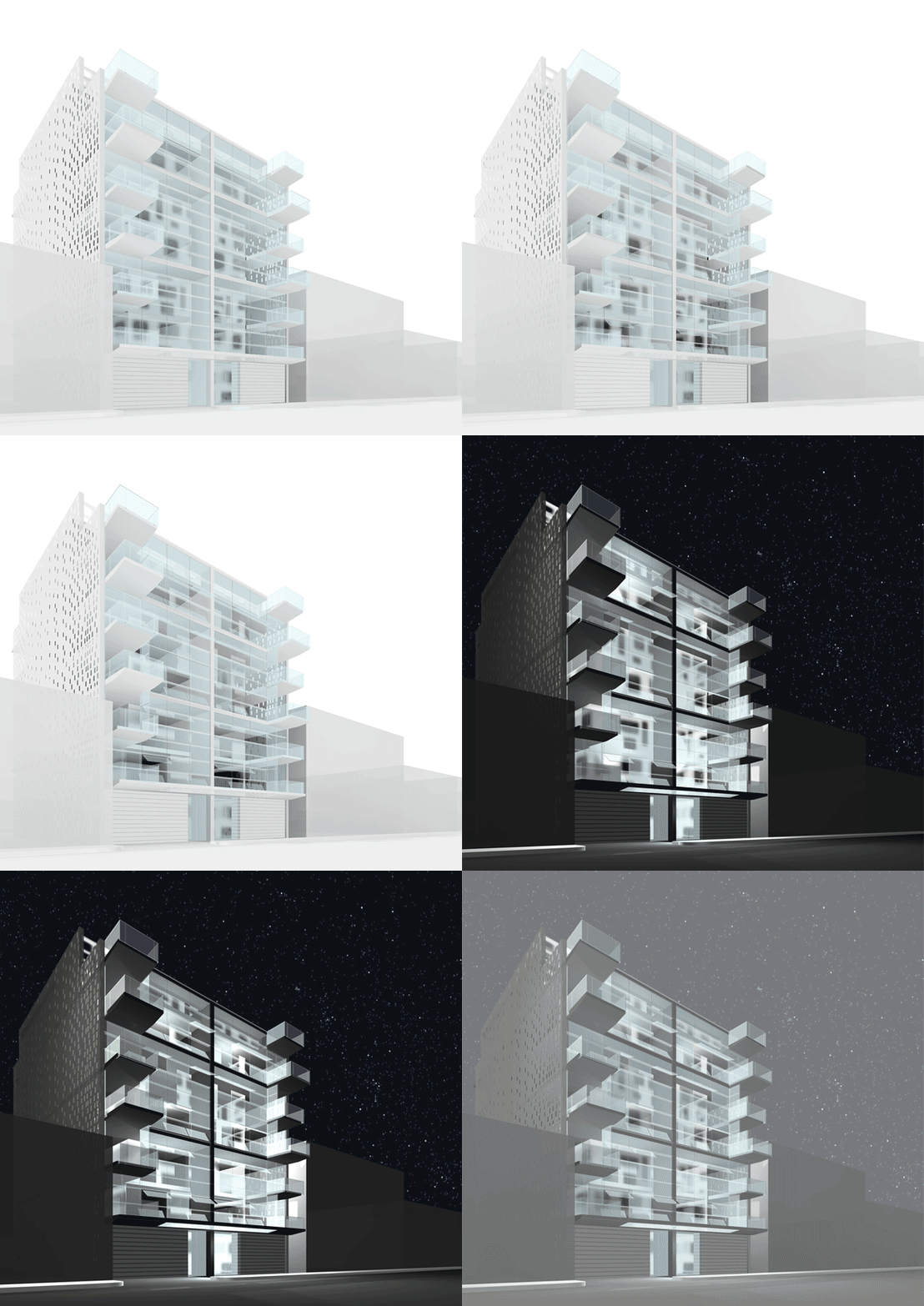
Rather than consider ‘Urban’ and ‘Soft’ as contradictory concepts, this project rethinks the terms as counterparts to one another. Instead of a series of windows that polarize notions of inside and outside, two transformable layers are utilized: The outer skin becomes a system of operable clear windows while the inner skin utilizes sliding panels with printed ‘windows’ that transition between clear and opaque. The space that is captured between these layers is a kind of ‘soft’ zone – neither outside nor inside, but a gradation between the two. From the interior, the additional perceptual depth allows users to innovate previous conceptions of the domestic.

soft lofts


 softlofts-typology
  soft lofts typology model

Typological Transformations: 

1.  The old-law ‘railroad’ tenement had little access to light and air.
2.  The new-law ‘dumbell’ tenement enforced small unnocupiable lightwells.
3.  Along with the rear-yard setback, soft lofts proposes a ’soft’ perimeter of occupiable light and air spaces. 

existing zoning
Existing Zoning:

Low 1 or 2 story warehouses are the defining characteristic that have attracted new residents(left).  The new zoning implies complete erasure with 5 or 6 story new construction.

softlofts - proposed zoning

Suggested Zoning:

By not lowering the proposed FAR, new construction could still be spliced into the existing fabric (left).   The sidewall could become a new layer  of history among the existing warehouse streetfronts.


soft party wall

The sidewall (or party wall) can become a new surface for bringing in light as well as an elevation that participates tangentially with the surrounding urban scene.  As only 15% of this wall can be glazed per code, the wall can be more effective as an overall distributed pattern rather than as a few isolated openings.


softlofts section softlofts panels

A skip-stop elevator allows duplex units.  The double-height soft zone between the interior and exterior is defined by sliding panels that can be configured by the user to  naturally vary the environmental performance and transparency of the space.


 dot_grey
PROJECT CREDITS:  

architect
Jinhee Park AIA, John Hong AIA/LEED (principals in charge), Frederick Peter Ortner, Erik Carlson, Anne Levallois, Sadmir Ovcina, Youngju Baik, Chris Minor, Hyeyoung Kim


RELATED PROJECTS:

 hbny mass college of art czech library providence plaza  
hbny  mass art czech library prov plaza  


dot_grey
index
<  works residential


 print post print post

Big Dig Building

Sunday, February 22nd, 2009

Cambridge, MA | 2005
[ Metropolis Next Generation Prize, Holcim Sustainable Construction Award ]

Most are familiar with Boston’s ongoing “Big Dig.” Few, however, give thought to the massive amount of waste that accompanies construction on this scale, namely the dismantling of the existing and temporary roadways. The Big Dig Building proposes to relocate and recycle these infrastructural materials as building components, adapting them to uses ranging from structural members to cladding. Furthermore, as these reused materials can withstand much higher loads than conventional building elements, the social ramifications of “heavy” in relation to “dwelling” can produce new and innovative results.

big dig building

highway to housing

From Highway to Housing:  What happens to the millions of tons of discarded materials from obsolete infrastructures like Boston’s Big Dig?  Destroying it costs millions to tax payers as well as wastes the embodied energy already stored in the materials.   Dismantled and relocated, concrete and  steel sections can become structural building modules adaptable to a variety of sites and programs.


infrastructure to architecture

load comparison

Load Comparisons: Standard framing (left) can withstand 40 psf – only standard residential objects and programs can be accomodated. The existing highway overpass (middle) is designed for HS20-44 military loading and can withstand 250 psf. The Big Dig Building using salvaged materials could withstand 200psf – How might a structure that can sustain 4x the load of standard residential construction change the way we dwell?

big dig building from street

Highway panels are shifted to create an elevation that reads as a vertical landscape.


big dig typologies

Like a prefabricated system, differing typologies from low to high densities can be created from the same salvaged infrastructural materials.  In this light, should not all infrastructural materials be more strategically designed with the second use already in mind? This ‘pre-cycling’ of structure would save them from become obsolete (and thus regarded as trash) and would conserve their massive amount of embodied energy for the lifespan of the material.

big dig building section
Cross section:  The assembly of infrastructural materials provides advantages such as long span undergroung parking, the integration of water filled trombe walls, and the ability to incorporate full scale landscapes on roofs and balconies.


big dig building interior

Because of the ability for the materials to carry heavy loads as well as span long distances, new programmatic freedoms can evolve.  Family playgrounds can be introduced into upper level units to provide immediate access to the outdoors (left), libraries and other heavy loads can be sustained within each unit (middle), and long spans making continuities between inside and outside can be achieved (right).

PROJECT CREDITS:

architect
John Hong AIA/LEED,  Jinhee Park AIA (principals in charge), Erik Carlson, Gentaro Miyano

structural design
Paul Pedini, Jay Cashman, Inc.


RELATED PROJECTS:

big dig house soft lofts    
big dig house soft lofts  


dot_grey
index
<  works residential


print post print post

Boston Harbor Pavilion

Sunday, February 8th, 2009

Boston, MA | 2005
[honorable mention, international competition]

It is the reciprocal edge between water and land that makes an island an extraordinary natural resource and public amenity. As an urban gateway to the Boston Harbor Islands, the structural roof-form or this design becomes a literal/metaphorical reference to this junction of water and land. Where the ‘actual’ site above the Central Artery prohibits excavation, the curvilinear roof-form is reflected onto a polished terrazzo map of the harbor islands implying the shoreline topography. This roof also collects runoff for reuse in the building and landscape while its downspouts become part of a demonstration water/land garden.

boston harbor front

Miesian space to figural space:   The transformation of the roof planes from horizontal to vertical creates a transition from continuous public openness to figural private enclosure.


folded paper gets stronger

Structural concept:  like a flat sheet, a flat slab of concrete will deflect and fail (left).  Folding this sheet greatly increases its strength.


boston harbor plan

The section of the building transforms from folded to flat – open public space containing ticketing and exhibition areas to private interior space containing restrooms and wash areas.
boston harbor model


boston harbor diagram   bostonharbor-map
water reclaiming as social event   boston harbor display

A singular shape performs in multiple ways.

boston harbor front


pavilion at night

In the evening, the pavilion becomes part of the linear eventscape illuminating the new greenway.


PROJECT CREDITS:

architect
Jinhee Park AIA (principal in charge), John Hong AIA/LEED (collaborating principal), Sadmir Ovcina, Frederick Peter Ortner, Erik Carlson, Hyeyoung Kim

structural engineer
Jaeseoung Lee, Weidlinger Associates Inc.


RELATED PROJECTS:

mass college of art boston city hall bac-sasaki asian cultural complex white stadium
mass art city hall bac sasaki acc white stadium


dot_grey
index <  works cultural


print post print post

Coulter House

Thursday, February 5th, 2009

Medfield, MA | 2008

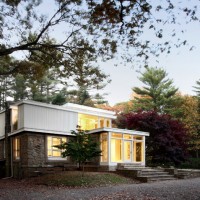
This addition above an existing structure expands the experience of the house without physically making it bigger.  The ‘interior-ness’ of the existing stone ground level is juxtaposed against the ‘exterior-ness’ of the new second level:  The light-weight and light-filled spaces of the new second floor are separated into 3 separate pavilions.  This fragmentation allows framed views to the surrounding landscape and new captured roof-gardens that both connect and separate the rooms.  Through energy efficient passive techniques including stack ventilation and the strategic use of overhangs, the need for mechanical summer cooling is eliminated.  In the winter the low-winter sun is harnessed to heat the thermally massive floor.

coulter house - dusk

coulter-existing

A new second story (above) replaced the original delapidated one (below).  A new entry porch was added to unify the new and original architectures.
-
-

coulter diagram

Instead of increasing the size of the house, the new upper level is conceived of as 3 pavilions (right).  The new spatial seams between the volumes  expand the experience of the spaces creating a dynamic spatial contrast with the inward looking existing ground floor spaces (left).

-
-
coulter seams
-
-

coulter bamboo garden

The space between the pavilions becomes a captured bamboo courtyard.


3 pavilions

3 pavilions: The concept diagram shows how dividing the program into 3 pavilions allows the house to stay small while extending the sense of space from inside to outside.
-
-
-coulter passive solar
Passive solar techniques: A roof overhang blocks high summer sun while allowing low winter sun keeping the thermally massive floor cool in the summer and hot in the winter.
-
-

coulter living before-after
A strategic cut in the ceiling connects the existing ground floor with the new 2nd floor (left).  Natural light and ventilation is now brought into a space that was originally dark and required artificial lighting even during the day (right).
-
-

coulter double heightThe double height space stack ventilates the house bringing cool air from below and releasing hot air through upper level clerestory windows.  The passive cooling techinique eliminates the need for air conditioning.
-
-

dot_grey
PROJECT CREDITS:
-

architect
Jinhee Park AIA (principal in charge), John Hong AIA/LEED (collaborating principal), Anne Levallois, Erik Carlson, Jiseok Park, Ann Ha

structural engineer
Tripi Engineering Services, LLC

contractor

Oteri Construction

fabrication
Osprey Design/Build


RELATED PROJECTS:

hbny 8 towers 1948 house
 
hbny 8 towers 1948 house


dot_grey
index <  works residential


-

print post print post

Big Dig House

Thursday, January 22nd, 2009

Lexington, MA | 2006
[AIA/BSA Housing Design Award, Metropolis Magazine Feature, Boston Globe Arts Feature, Business Week Feature]

As a prototype building that demonstrates how infrastructural refuse can be salvaged and reused, the structural system for this house is comprised of steel and concrete discarded from Boston’s Big Dig utilizing over 600,000 lbs of salvaged materials from elevated portions of the dismantled I-93 highway. Planning the reassembly of the materials in as if it were a pre-fab system, subtle spatial arrangements are created. These materials however are capable of carrying much higher loads than standard structure, easily allowing the integration of large scale roof gardens. Most importantly, the project demonstrates an untapped potential for the public realm: with strategic front-end planning, much needed community programs including schools, libraries, and housing could be constructed whenever infrastructure is deconstructed, saving valuable resources, embodied energy, and taxpayer dollars

bigdighouse_southeast_dusk

-

bigdighouse_inverset-load   bigdighouse_materials

Within 2 days, the house is framed: reusing steel structure and roadway panels from the big dig has sped up this phase of construction from 2 weeks to 12 hours.
-

bigdighouse_ne_3041

To minimize fabrication time and expense, the structural pieces were reused as-is.

-

bigdighouse_sequence4-small   bigdighouse_section

construction sequence (left) and section through living and roof garden (right).
-
-

bigdighouse_mezzanine_3294

Salvaged structural materials are left raw (left).  The roof garden connects to the living room and utilizes harvested rainwater (right).
-
-

bigdighouse_greatrm-easel_3268

Window walls in conjunction with double height spaces bring natural light deep in the space while exterior overhangs shade summer sun.


bigdighouse_nw_3039

-
-

dot_grey
PROJECT CREDITS:

architect
John Hong AIA /LEED, Jinhee Park AIA (principals in charge), Erik Carlson, Sadmir Ovcina, Chris Minor

structural design & construction
Paul Pedini, Jay Cashman, Inc.

structural engineer
Weidlinger Associates, Inc.

water management design
Cristina Perez-Pedini


RELATED PROJECTS:

big dig building mass college of art valentine houses
 
big dig bldg mass art valentine


dot_grey
index <  works residential


print post print post

8 Towers

Sunday, January 18th, 2009

Ordos 100 |  Inner Mongolia | 2010

SsD was included in a gobal selection of 100 architects curated by Ai WeiWei and Herzog and deMeuron.  The abstraction of the desert site is taken as an opportunity to develop new prototypical relationships between program and efficient energy use.  Each of the 8 towers contains a separate and distinct program: entry, living, food, exercise, sleeping, and bathing. Through the distortion of each tower’s geometry, the volumes join or separate creating strategic connections and segregations so that only occupied portions of the building need to consume energy.  The organization also creates experiential differences between rooms that are necessarily similar in size, while creating a high level of both porosity and privacy.  Finally, the strategy heightens the identity and iconography of each program promoting an intensity of accidental or intentional relationships between differing activities.


ordos100_south


each tower has a distinct program   8 towers - minimal occupancy

Different zones of the home are used at different times of day. dynamically adapting building systems to these patterns of use allows for greater energy-efficiency.


ordos100_sectbath

Separating the program into separate towers forms new spatial relationships while maximizing light and air to all rooms.


ordos100_front-living

The towers rise out of the desert – clay pots are integrated into the landscape design to manage runoff during flash rain storms (above).  Although the  towers are in dense proximity to form an advantageous microclimate, the angled walls allow clear views to the sky (right).

ordos100_structure
structural diagram: towers are able to lean by keeping the centroids of volumes within foundation line


dot_grey
PROJECT CREDITS:

architect
Jinhee Park AIA, John Hong AIA/LEED (principals in charge), Brett Albert, Frederick Peter Ortner, Matt Allen, Caroline Lang, Clara Wong, Bao Wei

structural engineer
Paul Kassabian, SGH


RELATED PROJECTS:

hbny


hbny


dot_grey
index <  works residential


print post print post