
Posts Tagged ‘commercial’

Big Dig Building

Sunday, February 22nd, 2009

Cambridge, MA | 2005
[ Metropolis Next Generation Prize, Holcim Sustainable Construction Award ]

Most are familiar with Boston’s ongoing “Big Dig.” Few, however, give thought to the massive amount of waste that accompanies construction on this scale, namely the dismantling of the existing and temporary roadways. The Big Dig Building proposes to relocate and recycle these infrastructural materials as building components, adapting them to uses ranging from structural members to cladding. Furthermore, as these reused materials can withstand much higher loads than conventional building elements, the social ramifications of “heavy” in relation to “dwelling” can produce new and innovative results.

big dig building

highway to housing

From Highway to Housing:  What happens to the millions of tons of discarded materials from obsolete infrastructures like Boston’s Big Dig?  Destroying it costs millions to tax payers as well as wastes the embodied energy already stored in the materials.   Dismantled and relocated, concrete and  steel sections can become structural building modules adaptable to a variety of sites and programs.


infrastructure to architecture

load comparison

Load Comparisons: Standard framing (left) can withstand 40 psf – only standard residential objects and programs can be accomodated. The existing highway overpass (middle) is designed for HS20-44 military loading and can withstand 250 psf. The Big Dig Building using salvaged materials could withstand 200psf – How might a structure that can sustain 4x the load of standard residential construction change the way we dwell?

big dig building from street

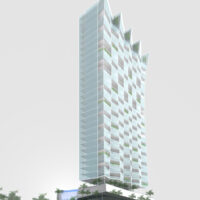
Highway panels are shifted to create an elevation that reads as a vertical landscape.


big dig typologies

Like a prefabricated system, differing typologies from low to high densities can be created from the same salvaged infrastructural materials.  In this light, should not all infrastructural materials be more strategically designed with the second use already in mind? This ‘pre-cycling’ of structure would save them from become obsolete (and thus regarded as trash) and would conserve their massive amount of embodied energy for the lifespan of the material.

big dig building section
Cross section:  The assembly of infrastructural materials provides advantages such as long span undergroung parking, the integration of water filled trombe walls, and the ability to incorporate full scale landscapes on roofs and balconies.


big dig building interior

Because of the ability for the materials to carry heavy loads as well as span long distances, new programmatic freedoms can evolve.  Family playgrounds can be introduced into upper level units to provide immediate access to the outdoors (left), libraries and other heavy loads can be sustained within each unit (middle), and long spans making continuities between inside and outside can be achieved (right).

PROJECT CREDITS:

architect
John Hong AIA/LEED,  Jinhee Park AIA (principals in charge), Erik Carlson, Gentaro Miyano

structural design
Paul Pedini, Jay Cashman, Inc.


RELATED PROJECTS:

big dig house soft lofts    
big dig house soft lofts  


dot_grey
index
<  works residential


print post print post

Verdant Studios

Sunday, February 15th, 2009

Athens, VT | 2006

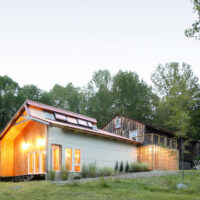
This recording studio for prominent recording engineer and musician Pete Weiss, solves specific issues of acoustics while engaging the site and context. An extension of an existing century-old barn, the new structure utilizes a transformation of the pitched roofs in the area: a simple ’scissor’ truss is mirrored to create both east and west skylights while on the interior, the asymmetrical space allows for a positive scattering of sound. The open end-bay of the structure telescopes views into the rural landscape and creates a rest area for musicians.

verdant studios

verdant roof

verdant scissor roof

A prefabricated  scissor truss is repeated and mirrored to allow for constant illumination throughout the day.

verdant porch

An inset front wall creates a porch-like space for musicians to take breaks within the verdant landscape.  The roof forms echo the existing house on the site.


verdant context

The project takes a deferential role to the larger natural context.


PROJECT CREDITS:

architect

John Hong AIA,LEED,  Jinhee Park AIA (principals in charge), Andy Hong, Erik Carlson

contractor
Don Clark


RELATED PROJECTS:

 coulter house 1948 house  
coulter house 1948 house


dot_grey
index <  works commercial

print post print post