SsD

architecture + urbanism

Braver House Featured in Dwell Magazine

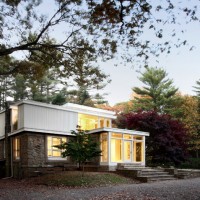
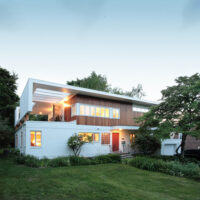
The Braver House, a prototype house that proposes an alternative to oversized suburban rebuilds is featured in the February issue of Dwell Magazine.

Share Button

Braver House completed

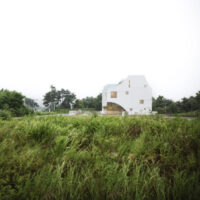
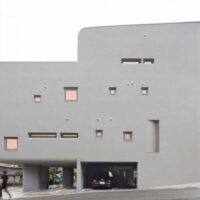
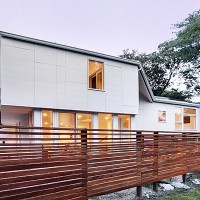
The Braver House  is an alternative for older suburbs where houses are being built to the setback line creating buildings much too big for their lots.  Instead we designed a small footprint house but built a screen to the maximum setback line.  This allows indoor spaces to extend to the exterior and also allows us to drastically reduce potable water use by eliminating a good portion of the suburban grass lawn.
Share Button

Braver House

Newton, MA | 2011
[ Dwell Magazine Feature Feb 2012 ]

In many older suburbs, the typical pattern of construction is to replace an existing house with a much larger one built out to the legal setbacks. The Braver House is a prototypical alternative: To instead build a small, efficient residence that simultaneously minimizes its actual footprint, while maximizing its perceived sense of interior space. This is achieved through two methods: By expanding a diaphanous screen to the setback line expanding the territory of the interior to the exterior, and by shifting the plan and section to capture elongated views from inside to outside. By claiming the under utilized lawn of the typical suburban yard and replacing it with permeable hardscape, potable water use is drastically reduced. In terms of minimizing energy use, the diminutive size of the house is coupled with a completely passive cooling system, a solar powered radiant heated floor and super insulated walls and roof.


Minimum Footprint / Maximum Permeability In older suburbs where landcost has multiplied, new rebuilds are typically built out to the legal setback line. The Braver House proposes a new minimum footprint solution where the sense of space is expanded by instead building a screen out to the setback line. If deployed as a prototype, a series of Braver Houses could increase the permeability of a catchment area decreasing the burden on municipal systems. Meanwhile energy use would be drastically reduced due to the smaller size.


Interior spaces are overlapped with the exterior: the wooden screen becomes a middle ground that defines expanded boundaries. In the living area (top), a high efficiency, low-emission wood burning stove supplements the solar powered radiant floor heating system. Its proximity to the passive stack directly opposite from it allows heat to be drawn into the upper floors of the house.  A renewable cork floor is used throughout the house. Its color is matched with the exterior screen to create visual and spatial continuity.


1st Floor Plan: Each interior space has a reciprocal exterior space – for instance the living and dining areas have their counterpart directly opposite a set of floor to ceiling windows so that the landscape screen becomes the the 'outside' rather than the envelope of the house.

View of sideyard: The openness of the ground floor is screened from neighbors while cantilevered 2nd floor areas provide shading for the ground floor. The strategically asymmetrical pitch of the roof conceals an array of solar panels while maximizing their solar exposure.
 

Beginning with the existing site slope, the house is shifted in both plan and section: Although the rooms are small, oblique views expand the sense of space.

Instead of foreshortened frontal views, the shift in plan extends views obliquely through the sideyard.
 

The shift in plan and section extends views through the public areas of the house and to the yard beyond.

Second Floor Plan (left): The spaces are organized around a vertical ventilation and plumbing core.  The gently sloping stair (right) creates a vertical continuity between the elements of the house.

The stair wraps around the infrastructural core and becomes a protagonist as it moves through the house organizing adjacent spaces and views to the outside (top and left). From the master bedroom (right) the interior of the stair becomes an ‘exterior.’


At the core of the house, a passive stack vents warm air through an operable skylight and brings daylight into the building's center.  The natural flow of air eliminates the need for mechanical air conditioning
 
 
The combination of the screens and overall massing allow the project to read not as a single structure, but as a pair of smaller pavilions with landscape in between. Replacing the yard within the screens with permeable hardscape drastically reduces the use of potable water while maintaining the decreased area of grass outside the screen allows the project to 'blend in' with its neighbors.


PROJECT CREDITS:

architect
John Hong  AIA, LEED + Jinhee Park  AIA  (principals in charge), Matthew Allen, Frederick Peter Ortner, Christoph Schäfer, Aleta Budd, Brian Vester, Nathalie Zegarra

construction manager
Osprey Design/Build LLC

structural engineer
Evan Hankin


RELATED WORKS:

8 towers coulter house hbny verdant studios
8 towers hidden house coulter house hbny verdant studios

dot_grey

print post print post


Share Button

Bean Residence completed

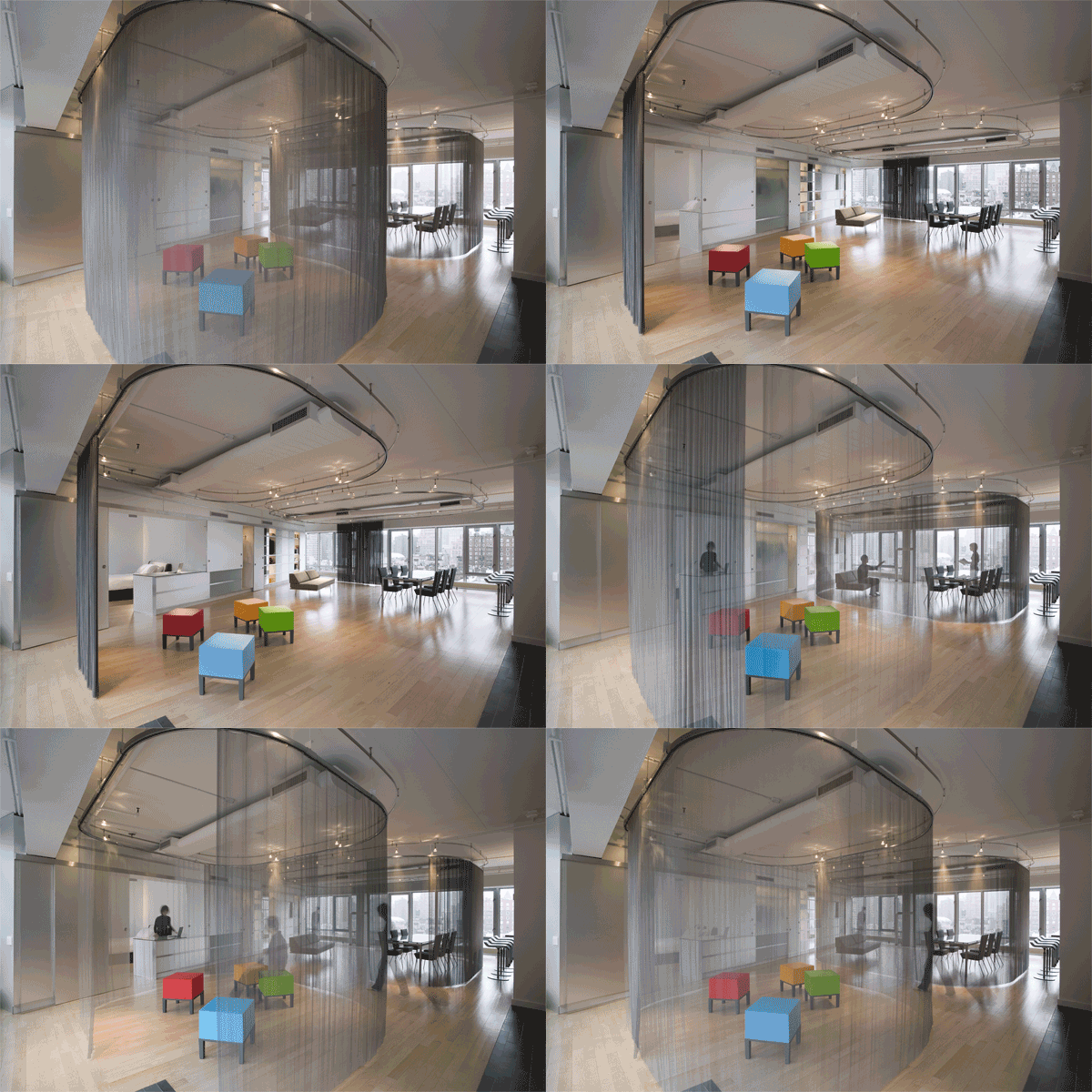
The bean residence is a 2400 sf gut renovation in Manhattan. The existing layout fragmented public areas and did not take advantage of natural light.  Through the reconfiguration of the plan and introducing a restrained palette of materials, underutilized spaces become connective zones.  Where the deep floorplate limited the amount of daylight, LED lighting in conjunction with frosted mirrored surfaces emit daylight rendered tones from the side as well as above giving continuity with adjacent sunlit areas.

Share Button

Hidden Fortune House

Cambridge, MA | 2010

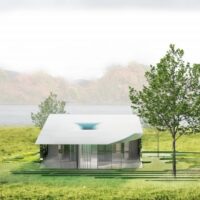
The Hidden Fortune House is a a 350 square foot addition to an existing historical residence. The project’s diminutive size is deceptive: Placed between the interior collective areas of the existing house and the exterior garden, it is conceived of as not an autonomous object, but as an extended frame that forms new spatial connections and continuities. Its folded zinc clad shape (likened to a fortune cookie) negotiates the goal of creating a light and lofty space with the reality of restrictive zoning processes.  Built-in shelving increases the efficiency and flexibility of the space dramatically while making the storage appear compact and part of the interior walls. Innovatively pushing the geometric limits of prefabricated SIP panels, a nuanced geometry (rather than the default box-like form of pre-fab architecture) extends views, shades afternoon sun, and mediates scale differences within the urban context.


The window wall in relationship to the profile of the roof and ceiling allows the view to expand toward the garden and the sky.

Although the new family room is small, it is designed as the connecting space to the other public areas of the house extending views outside to the garden.  The profile of the ceiling as it meets the window wall increases the amount of natural light without adding to glare while also providing a sense of spatial extension beyond the height of the ceiling.  Like the building frame itself, the shelving system is a series of modular boxes, with and without cabinet doors, that can be configured in various ways.

A half level down from the existing public areas of the house, the new addition connects the garden with the kitchen.  The stair then occupies the zone of the folded ceiling to connect a path to the outside using natural light as a cue (left).  A skylight brings light into the kitchen (right) while framing an extended view to the sky.  A perforated aluminum balcony screens one space from the other while also allowing visual continuity.


PROJECT CREDITS:

architect
John Hong AIA, LEED + Jinhee Park AIA (principals in charge), Frederick Peter Ortner, Trevor Patt, Stephen Fan

construction manager
Osprey Design/Build LLC
 

RELATED PROJECTS:

coulter house verdant studios  
coulter house infinite box verdant studios braver house  

dot_grey
 

print post print post
Share Button

Soft Lofts

Brooklyn, NY | 2007

Rather than consider ‘Urban’ and ‘Soft’ as contradictory concepts, this project rethinks the terms as counterparts to one another. Instead of a series of windows that polarize notions of inside and outside, two transformable layers are utilized: The outer skin becomes a system of operable clear windows while the inner skin utilizes sliding panels with printed ‘windows’ that transition between clear and opaque. The space that is captured between these layers is a kind of ‘soft’ zone – neither outside nor inside, but a gradation between the two. From the interior, the additional perceptual depth allows users to innovate previous conceptions of the domestic.

soft lofts


softlofts-typology
  soft lofts typology model

Typological Transformations:  1.  The old-law 'railroad' tenement had little access to light and air. 2.  The new-law 'dumbell' tenement enforced small unnocupiable lightwells. 3.  Along with the rear-yard setback, soft lofts proposes a 'soft' perimeter of occupiable light and air spaces.  existing zoning
Existing Zoning: Low 1 or 2 story warehouses are the defining characteristic that have attracted new residents(left).  The new zoning implies complete erasure with 5 or 6 story new construction.

softlofts - proposed zoning
Suggested Zoning: By not lowering the proposed FAR, new construction could still be spliced into the existing fabric (left).   The sidewall could become a new layer  of history among the existing warehouse streetfronts.

soft party wall

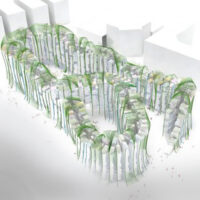
The sidewall (or party wall) can become a new surface for bringing in light as well as an elevation that participates tangentially with the surrounding urban scene.  As only 15% of this wall can be glazed per code, the wall can be more effective as an overall distributed pattern rather than as a few isolated openings.


softlofts section softlofts panels

A skip-stop elevator allows duplex units.  The double-height soft zone between the interior and exterior is defined by sliding panels that can be configured by the user to  naturally vary the environmental performance and transparency of the space.


dot_grey
PROJECT CREDITS:  

architect
Jinhee Park AIA, John Hong AIA/LEED (principals in charge), Frederick Peter Ortner, Erik Carlson, Anne Levallois, Sadmir Ovcina, Youngju Baik, Chris Minor, Hyeyoung Kim


RELATED PROJECTS:

 hbny mass college of art czech library    
hbny  mass art czech library    

dot_grey

print post print post
Share Button

Valentine Houses

Cambridge, MA | 2003
[BSA/AIA NY Housing Design Award 2004, Dwell Magazine feature Oct 2004, BSA Honor Award Citation 2003]

valentine house

The 3 new townhouses transform Cambridgeport's woodframe type, dynamically addressing boundaries between inside and outside, private and community. A critique of the inward looking 'winterized box,' the project incorporates double height interior/exterior spaces, cantilevered garden-balconies, and occupiable shared roof-planes — all of which become an architectural language for further urban developments.


valentine - view from back  

zoning study
valentine zoning study


valentine sections

Longitudinal section (left) and cross section (right):  Double height spaces maximize natural light and allow for cross ventilation throughout the townhouses.


valentine project wall   valentine windows

Differing window types negotiate interior and exterior:  Window walls present direct views to the outside, blank walls allow for the projection of virtual views, and high apertures (right) track the time of day.


valentine roofdeck

A shared roofgarden extends the interior space of the units.


valentine light and air snorkel   valentine backyard

A light and air snorkel (left) is utilized to bring sunlight into more 'buried' spaces and promote stack ventilation.  Highly permeable sideyards mitigate runoff from adjacent sites (right)
 

valentine double height

A double height space (left) combines programs of living, dining and mezzanine office.  From the exterior, this space is screened by a bamboo planter bed integrated into the wall.


PROJECT CREDITS:

architect
John Hong AIA /LEED, Jinhee Park AIA, Andy Hong, Erik Carlson, Johanna Niles, Thos Niles

structural engineer
Sarkis Zerounian & Associates

construction
Azzam Development & Design, Inc.

custom fabrication
Jake Forster, Letterbox Productions

landscape
Boston Landscape Co.

photography
Erik Gould Photography


RELATED PROJECTS:

big dig house verdant studios 1948 house    
big dig house verdant 1948 house    

dot_grey

print post print post
Share Button

Big Dig Building

Cambridge, MA | 2005
[ Metropolis Next Generation Prize, Holcim Sustainable Construction Award ]

big dig building

Most are familiar with Boston's ongoing "Big Dig." Few, however, give thought to the massive amount of waste that accompanies construction on this scale, namely the dismantling of the existing and temporary roadways. The Big Dig Building proposes to relocate and recycle these infrastructural materials as building components, adapting them to uses ranging from structural members to cladding. Furthermore, as these reused materials can withstand much higher loads than conventional building elements, the social ramifications of "heavy" in relation to "dwelling" can produce new and innovative results.

highway to housing

From Highway to Housing:  What happens to the millions of tons of discarded materials from obsolete infrastructures like Boston's Big Dig?  Destroying it costs millions to tax payers as well as wastes the embodied energy already stored in the materials.   Dismantled and relocated, concrete and  steel sections can become structural building modules adaptable to a variety of sites and programs.

infrastructure to architecture

load comparison

Load Comparisons: Standard framing (left) can withstand 40 psf – only standard residential objects and programs can be accomodated. The existing highway overpass (middle) is designed for HS20-44 military loading and can withstand 250 psf. The Big Dig Building using salvaged materials could withstand 200psf – How might a structure that can sustain 4x the load of standard residential construction change the way we dwell?

big dig building from street

Highway panels are shifted to create an elevation that reads as a vertical landscape.

big dig typologies

Like a prefabricated system, differing typologies from low to high densities can be created from the same salvaged infrastructural materials.  In this light, should not all infrastructural materials be more strategically designed with the second use already in mind? This 'pre-cycling' of structure would save them from become obsolete (and thus regarded as trash) and would conserve their massive amount of embodied energy for the lifespan of the material.
 

big dig building section
Cross section:  The assembly of infrastructural materials provides advantages such as long span undergroung parking, the integration of water filled trombe walls, and the ability to incorporate full scale landscapes on roofs and balconies.


big dig building interior

Because of the ability for the materials to carry heavy loads as well as span long distances, new programmatic freedoms can evolve.  Family playgrounds can be introduced into upper level units to provide immediate access to the outdoors (left), libraries and other heavy loads can be sustained within each unit (middle), and long spans making continuities between inside and outside can be achieved (right).
 

PROJECT CREDITS:

architect
John Hong AIA/LEED,  Jinhee Park AIA (principals in charge), Erik Carlson, Gentaro Miyano

structural design
Paul Pedini, Jay Cashman, Inc.


RELATED PROJECTS:

big dig house soft lofts      
big dig house soft lofts  

dot_grey

print post print post
Share Button

Big Dig House

Lexington, MA | 2006
[AIA/BSA Housing Design Award, Metropolis Magazine Feature, Boston Globe Arts Feature, Business Week Feature]

 bigdighouse_southeast_dusk
As a prototype building that demonstrates how infrastructural refuse can be salvaged and reused, the structural system for this house is comprised of steel and concrete discarded from Boston’s Big Dig utilizing over 600,000 lbs of salvaged materials from elevated portions of the dismantled I-93 highway. Planning the reassembly of the materials in as if it were a pre-fab system, subtle spatial arrangements are created. These materials however are capable of carrying much higher loads than standard structure, easily allowing the integration of large scale roof gardens. Most importantly, the project demonstrates an untapped potential for the public realm: with strategic front-end planning, much needed community programs including schools, libraries, and housing could be constructed whenever infrastructure is deconstructed, saving valuable resources, embodied energy, and taxpayer dollars.
 

-

bigdighouse_inverset-load   bigdighouse_materials

Within 2 days, the house is framed: reusing steel structure and roadway panels from the big dig has sped up this phase of construction from 2 weeks to 12 hours.
-

bigdighouse_ne_3041

To minimize fabrication time and expense, the structural pieces were reused as-is.

-

bigdighouse_sequence4-small   bigdighouse_section

construction sequence (left) and section through living and roof garden (right).
-
-

bigdighouse_mezzanine_3294

Salvaged structural materials are left raw (left).  The roof garden connects to the living room and utilizes harvested rainwater (right).
-
-

bigdighouse_greatrm-easel_3268

Window walls in conjunction with double height spaces bring natural light deep in the space while exterior overhangs shade summer sun.


bigdighouse_nw_3039

-
-

dot_grey
PROJECT CREDITS:

architect
John Hong AIA /LEED, Jinhee Park AIA (principals in charge), Erik Carlson, Sadmir Ovcina, Chris Minor

structural design & construction
Paul Pedini, Jay Cashman, Inc.

structural engineer
Weidlinger Associates, Inc.

water management design
Cristina Perez-Pedini


RELATED PROJECTS:

big dig building mass college of art valentine houses    
big dig building mass art valentine    

dot_grey

print post print post
Share Button