SsD

architecture + urbanism

Last chance to see Convergent Flux

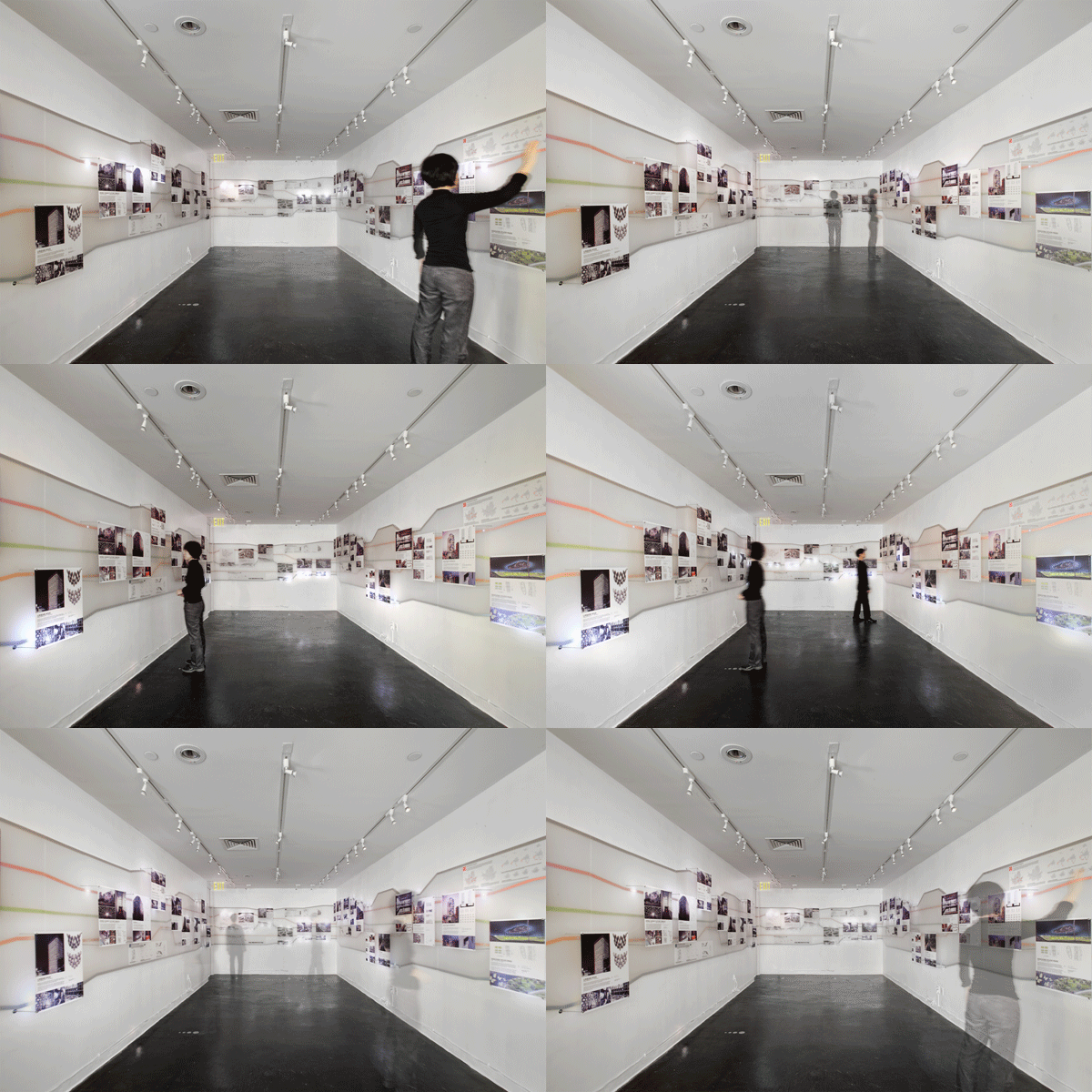
This is the final week of the exhibit, Convergent Flux: Korea at the Korea Society, an interactive exhibition on contemporary Korean architecture, landscape architecture, and urban design first shown at the Harvard GSD, curated by Jinhee Park and John Hong. Please feel free to visit the gallery at: 950 3rd Avenue, 8th Floor, New York, NY 10022.  We will keep you posted on the future of the exhibit content…

The Center for Arts at the Armory is completed

In terms of preservation strategies, armories are truly a difficult urban building type.  Once a place for military training, they are now becoming almost wholly obsolete:  Their vast interior drill hall and their monumental footprint makes them difficult to convert to any other urban program including housing.  Meanwhile, many of them appear on highly restrictive state or national historic registers.  This confounds developers further as surrounding land costs and thus development intensity has multiplied around these buildings but the restrictions placed on renovating them makes it impossible to increase their density and make the numbers work.

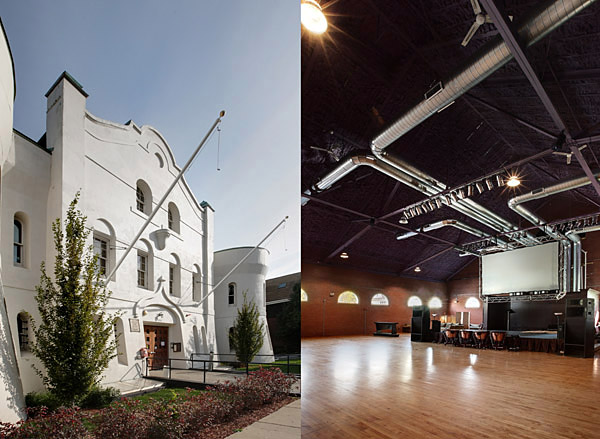
The Somerville Armory is one such building.  Nestled in an otherwise dense residential zone, it sat underutilized for years, slowly deteriorating.  After the building was courageously acquired by the Highland Avenue Trust, we worked with them, the Arts at the Armory, the City of Somerville, and the Massachusetts State Historical Commission to adaptively re-use the structure into a  regional, 30,000 sf non-profit arts center that houses a multitude of community oriented programs including NGO’s, artists, dance, and music studios and offices, galleries, arts education and after school programs, and a cafe/performance space.  The building’s anchor is the former drill hall which now serves as a multi-use space that host a variety of community programs, concerts, and educational venues.

Czech National Library

Prague, Czech Republic | 2006 [international competition, jury selection]

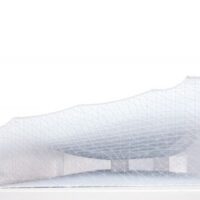
As both a secure repository of books and a symbolic civic building, a national library must negotiate the spatial dichotomy between storage and display. Through a strategy of 'light monumentality' the book stacks are formed into a curved two-way truss that protects and defines a public winter-garden below it. During the day, its specular surface reflects the surrounding cityscape, while at night an internal illumination reveals the massive amount of books and knowledge within. The curved form itself organizes a system of ramped stacks and reading rooms that allow new interactive relationships between books and their viewers.-

czechlibrary_dusk


czechlibrary_books   czechlibrary_papercut

books can be seen as a surface (left).  This surface becomes volumetric as stacks are organized along a continuously sloping ramp (right).


czechlibrary_elev-day-nt

During the day, the interior curved skin reflects the urban surrounds while protecting the collections from sunlight.  During the night, the interior of the book stacks is revealed.


czechlibrary_model   czechlibrary_struct

View of model (left).  Structural diagram (right).

-

czechlibrary_stacks-in00

From the interior, the rear of the stacks become an organizing apparatus: the user can quickly identify the destinatiion

- -

czechlibrary_stacks-out00

From the ground level, the sloping floor of the open stacks allows views into them: the contents of the library become shared cultural property.


czechlibrary_elev-back

view of back elevation


czechlibrary_sustainable

Sustainability strategies: The refractive geometry of the exterior structure/skin in conjunction with the curved interior glass skin allows diffuse natural light to enter deep into the building. The winter garden combined with the curved volume is used to bring cool air from lower levels and vent rising hot air.  Rain water is filtered and reused for secondary uses including building mechanical systems and toilets.

dot_grey
PROJECT CREDITS:

architect
Jinhee Park AIA, John Hong AIA/LEED (principals in charge), Catarina Marques, Chris Minor, Nathan Fash, Ann Ha, Behrang Behin, Erik Carlson

structural engineer
Jaeseoung Lee (Weidlinger Associates Inc.)


RELATED PROJECTS:

asian cultural complex boston city hall hbny    
acc boston city hall hbny    

dot_grey


print post print post