SsD

architecture + urbanism

SsD is selected as a finalist in the Incheon City Design Competition

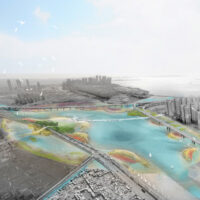
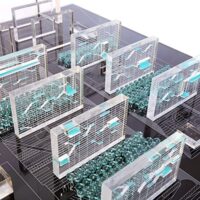
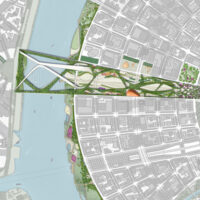
SsD has been selected as a finalist in an international competition in Incheon, Korea. We propose recovering Incheon’s lost maritime history by recreating an inland sea around its Ahamdo island - now threatened to be infilled by adjacent urban development – allowing it to be an island once again. This sea will incorporate artificial reefs to shelter a delicate wetland ecosystem with an urban wilderness park running through it. A floating pedestrian bridge, reminiscent of the historical path to Ahamdo, will be the new destination that connects Incheon to its new waterfront district.

SsD teams with Parkkim and Jegong Architects: wins 2nd place in major urban design competition

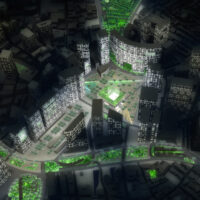
SsD focused on sustainable low-rise / high-density urbanism for this new waterfront city south of Seoul.  Although the design of the new urban parcels are strategically individualzed and limited in scale, as a whole they work in conjunction with each other in contributing to an overall energy and resource strategy:  By working as a single entity rather than a fragmented whole,  solar energy is harnessed, water runoff controlled, prevailing winds captured for passive cooling, and public space aggregated into a larger cohesive network that links surrounding topographies.

In keeping with this theme that the ’whole is greater than the sum of its parts,’ the 2nd place win against four of the largest firms in Korea is  ’partial confirmation’ that a collaborative of smaller firms can form a strong interdisciplinary team able to compete on an international level.

Emerald Kilometer

Thu Thiem, Vietnam | 2008

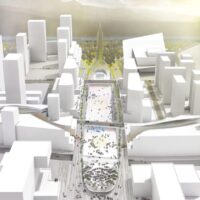
The proposed plaza, park, and bridge hosts ceremonial and everyday events in a new mixed-use district for Ho Chi Minh City in Vietnam. Our project creates a kilometer long plaza, green in its physical presence, green in its construction and dynamically scalable to the events of the city. Floating above the entire plaza and bridge is a monumental pergola, a filigree of steel cables covered in flowering vines, the patterns of the openings creating an ever changing play of shadow and light. This unifying roof turns the plaza into a single super-scaled outdoor living room. At the same time, a panoply of differently scaled openings create a series of perceptual spaces of different sizes, intimate at the lake end and becoming progressively more grand as they approach the Saigon River.

Comparison of Plaza Sizes:A network of paths and spaces defined by the landscape canopy extends over the river and creates the perception of a lengthened plaza that connects the two sections of the city.

As well as providing shade for the plaza, the urban scale canopy defines a multitude of programmatic activities and scales to animate the space around the clock.


The canopy and paving work in conjunction as a new infrastructure:  Both overhead photo-voltaics in the canopy and under-foot Piezo-electric flooring generates energy which then powers the lighting and public wi-fi installed in the canopy.  Runoff water collected from the permeable paving is filtered and re-used for public restrooms and to drip irrigate the canopy vines.

dot_grey
PROJECT CREDITS:

architect
Jinhee Park AIA + John Hong AIA, LEED (principals in charge), Jonathan Louie, Matthew Allen, Frederick Peter Ortner, Brett Albert, Daniel Cashen

landscape architect
Ground, Inc.


RELATED PROJECTS:

boston city hall mass college of art      
boston city hall mass art      

dot_grey
 

print post print post

Boston City Hall

Boston, MA | 2007
[Architecture Boston Feature]

Boston City Hall occupies one of the best pieces of land in Boston. At the intersection of 3 major subway lines and at the geographical heart of downtown, this is an ideal location for a dynamic civic center; however the current City Hall is accused of failing to interface effectively with the public. We propose taking advantage of a latent urban potential: The site is the missing link between the historic Fenway Park and the new Rose Kennedy Greenway.  By allowing the plaza to connect these important open spaces, City Hall will sit pavilion-like in a park, much like a New England meeting house at the center of urban life. Opening the City Hall to its surroundings and reprogramming it with public functions such as a meeting hall, a community/ cultural center, and a civic history museum will also make it an integral part of Boston's historical 'Freedom Trail.'
 

boston city hall

Aerial view of city hall:  At the infrastructural scale, the plaza surface is opened so that light and air can connect of the 3 buried subway lines to the activities of the plaza.  At the urban scale the greening of the plaza allows it to join the Fenway and the Rose Kennedy Greenway.
 

connecting fenway with the greenway freedom trail

The plaza has the latent potential to provide the much needed connection between Fenway Park and the Rose Kennedy Greenway (left).  New public programs at City Hall can allow it to become a new addition to the 'Freedom Trail.' (right).


boston city hall plaza plaza lights

Revealing the red, green, and blue subway lines brings new public activity to the surface of the plaza.
 

city hall section

Section through the plaza: Natural light and ventilation brought to the subway levels can also allow for new programs to be added underneath the plaza.


PROJECT CREDITS:

architect
Jinhee Park AIA + John Hong AIA/LEED (principals in charge), Frederick Peter Ortner, Catarina Marques, Jiseok Park


RELATED PROJECTS:

asian cultural complex czech library boston harbor pavilion    
acc czech library boston harbor    

dot_grey

print post print post