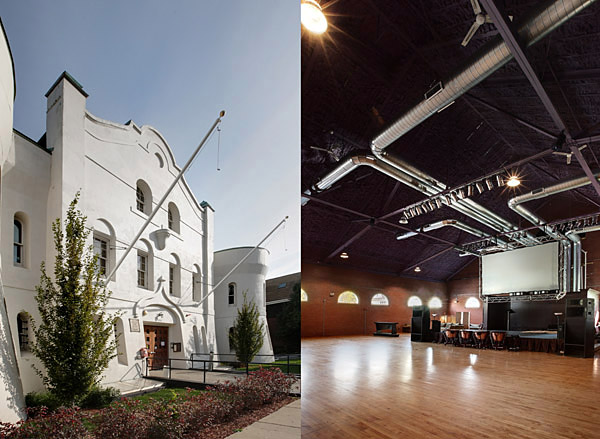
In terms of preservation strategies, armories are truly a difficult urban building type. Once a place for military training, they are now becoming almost wholly obsolete: Their vast interior drill hall and their monumental footprint makes them difficult to convert to any other urban program including housing. Meanwhile, many of them appear on highly restrictive state or national historic registers. This confounds developers further as surrounding land costs and thus development intensity has multiplied around these buildings but the restrictions placed on renovating them makes it impossible to increase their density and make the numbers work.
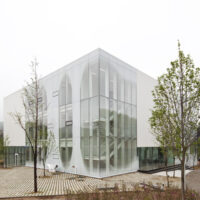
The Somerville Armory is one such building. Nestled in an otherwise dense residential zone, it sat underutilized for years, slowly deteriorating. After the building was courageously acquired by the Highland Avenue Trust, we worked with them, the Arts at the Armory, the City of Somerville, and the Massachusetts State Historical Commission to adaptively re-use the structure into a regional, 30,000 sf non-profit arts center that houses a multitude of community oriented programs including NGO’s, artists, dance, and music studios and offices, galleries, arts education and after school programs, and a cafe/performance space. The building’s anchor is the former drill hall which now serves as a multi-use space that host a variety of community programs, concerts, and educational venues.
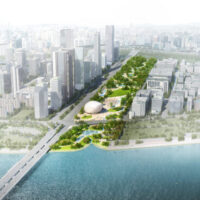
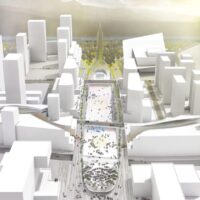
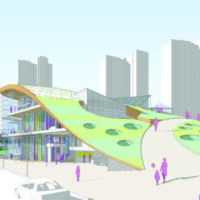
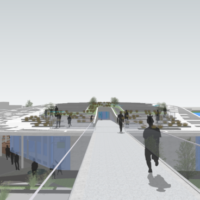
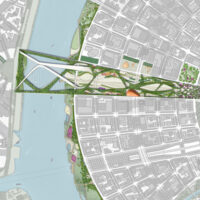
The proposed plaza, park, and bridge hosts ceremonial and everyday events in a new mixed-use district for Ho Chi Minh City in Vietnam. Our project creates a kilometer long plaza, green in its physical presence, green in its construction and dynamically scalable to the events of the city. Floating above the entire plaza and bridge is a monumental pergola, a filigree of steel cables covered in flowering vines, the patterns of the openings creating an ever changing play of shadow and light. This unifying roof turns the plaza into a single super-scaled outdoor living room. At the same time, a panoply of differently scaled openings create a series of perceptual spaces of different sizes, intimate at the lake end and becoming progressively more grand as they approach the Saigon River.
Comparison of Plaza Sizes:A network of paths and spaces defined by the landscape canopy extends over the river and creates the perception of a lengthened plaza that connects the two sections of the city.
As well as providing shade for the plaza, the urban scale canopy defines a multitude of programmatic activities and scales to animate the space around the clock.
The canopy and paving work in conjunction as a new infrastructure: Both overhead photo-voltaics in the canopy and under-foot Piezo-electric flooring generates energy which then powers the lighting and public wi-fi installed in the canopy. Runoff water collected from the permeable paving is filtered and re-used for public restrooms and to drip irrigate the canopy vines.
PROJECT CREDITS:
architect
Jinhee Park AIA + John Hong AIA, LEED (principals in charge), Jonathan Louie, Matthew Allen, Frederick Peter Ortner, Brett Albert, Daniel Cashen
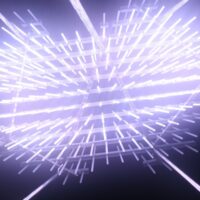
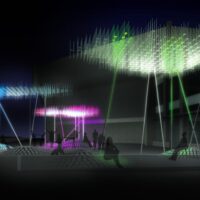
An electronic "cloud" canopy formed of an array of LED's and speakers are triggered by passerbys and weather patterns heightening otherwise invisible relationships between publics and their environments. As groups begin to gather, the interactive electronics intensify, promoting impromptu performances and conversations. Urban landscape mounds form lounging areas as well as define new paths.
You need to install or upgrade Flash Player to view this content, install or upgrade by clicking here.
A simple weather station inputs data to the canopy and allows it to interactively extend the experience of the weather by mixing visual and auditory information with the people's use patterns (left). Direct and indirect paths are defined by the canopy (right).
You need to install or upgrade Flash Player to view this content, install or upgrade by clicking here.
Light and sound augment the experience of wind (left). The plan of the canopy (right) depicts how irregular edges can be created out of the LED grid (right).
You need to install or upgrade Flash Player to view this content, install or upgrade by clicking here.
During hot days, cool lighting and sound are emitted (left). An undulating landscape allows users to create their own interpretations of how the plaza space can be used (right).
You need to install or upgrade Flash Player to view this content, install or upgrade by clicking here.
Even when the electronics are off, a moire effect created by the canopy components gives the appearance that the cloud canopy is shifting and transforming as one moves around the plaza (left). A detail of the canopy light rods shows the simplicity of the structure (right).
PROJECT CREDITS:
architect
Jinhee Park AIA, John Hong AIA/LEED (principals in charge), Erik Carlson (Area C), Catarina Marques, Frederick Peter Ortner
Boston, MA | 2005
[honorable mention, international competition]
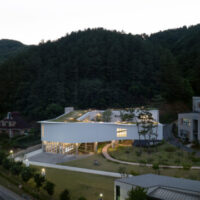
It is the reciprocal edge between water and land that makes an island an extraordinary natural resource and public amenity. As an urban gateway to the Boston Harbor Islands, the structural roof-form or this design becomes a literal/metaphorical reference to this junction of water and land. Where the 'actual' site above the Central Artery prohibits excavation, the curvilinear roof-form is reflected onto a polished terrazzo map of the harbor islands implying the shoreline topography. This roof also collects runoff for reuse in the building and landscape while its downspouts become part of a demonstration water/land garden.
Miesian space to figural space: The transformation of the roof planes from horizontal to vertical creates a transition from continuous public openness to figural private enclosure.
Structural concept: like a flat sheet, a flat slab of concrete will deflect and fail (left). Folding this sheet greatly increases its strength.
The section of the building transforms from folded to flat – open public space containing ticketing and exhibition areas to private interior space containing restrooms and wash areas.
A singular shape performs in multiple ways.
In the evening, the pavilion becomes part of the linear eventscape illuminating the new greenway.
PROJECT CREDITS:
architect
Jinhee Park AIA (principal in charge), John Hong AIA/LEED (collaborating principal), Sadmir Ovcina, Frederick Peter Ortner, Erik Carlson, Hyeyoung Kim
structural engineer
Jaeseoung Lee, Weidlinger Associates Inc.