Posts Tagged ‘structure’

BAC-Sasaki Exhibition

Friday, April 10th, 2009

Boston, MA | 2007

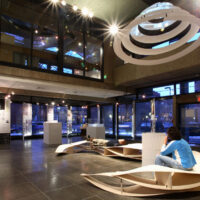
SsD was selected to design and exhibit recent work in the BAC gallery on Newbury Street in Boston as well as teach a cross-discplinary studio as Distinguished Visiting Critics.  Funded by the Hideo Sasaki Foundation, the work revolved around the notion of  ’socio-structural’ – how structural solutions can converge with ideas of shaping social space.   Large scale models that tested the principles  at a human scale became the center of the exhibit.  Translucent panels lit from within exhibiting additional project images  modulated the view from the active storefront into the gallery space.

bac sasaki exhibit
ACC bench with Czech Library ramp above


bac exhibit
Digital fabrication techniques were used to move beyond the scale of the model to the architectural scale artifact.


bac panels
Illimunated display panels transform the visual grain of the existing storefront to either foreground the  panels or allow views to the objects in the background.


PROJECT CREDITS:

design and construction
Jinhee Park AIA (principal in charge), John Hong AIA/LEED (collaborating principal), Catarina Marques, Chris Ryan, Leehong Kim, Frederick Peter Ortner, Nathan Fash


RELATED PROJECTS:

asian cultural complex czech library boston harbor pavilion providence plaza  
acc czech library boston harbor prov plaza  


dot_grey
index <  works cultural


print post print post

Asian Cultural Complex

Monday, April 6th, 2009

Gwangju, Korea | 2005
[honorable mention, international competition]

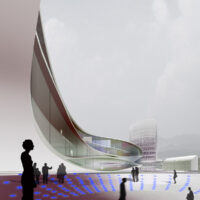
The act of encircling has both literal and metaphorical meanings: In an urban environment like Gwangju, encircling implies both the demarcation of a special precinct within the city’s existing fabric as well as the creation of a new public common ground. Providing a porous, non-hierarchical edge to the urban surrounds, our encircling form expands the democratic territory of the existing Gwangju Fountain into a cultural complex and park on an urban scale. Through the use of a new socio-structural concept in the continuous deflected arch, continuities and reciprocal relationships between the diverse cultural programs within the building are enabled.

asian cultural complex


SOCIO-STRUCTURAL CONCEPT

1. A flat slab proves inefficient in spanning long distances.

2. Deflection causes the flat slab to fail.

3. A deflected slab in conjunction with an arched slab creates an efficient long-span structure that allows interweaving of programs

  acc socio-structural

acc elevation

UNFOLDED ELEVATION
A continuous undulating walkway becomes a linear public amenity: public spectacles and performances interweave with the building program.


acc theater

The deflected structure allows the theater program to extend onto the green roof.


acc plan   acc urban diagram


5 elements plazas

FIVE ELEMENTS PLAZAS
To aid orientation as well as to tie current material culture to more ancient asian notions of nature, five plazas symbolizing the essential forces of nature mark the site entry points.


acc axis

As well as create a space for existing historical buildings and fountain, the project creates an urban scale terminus for the city’s major artery.

acc sustainability

SUSTAINABLE STRATEGIES
The undulating form allows cross ventilation of the site while the tower harnesses wind currents channeled from the adjacent mountains.   A fully planted green roof across the entire building roof along with a new porous park contains all the stormwater onsite.  Geothermal loops augment the building’s mechanical systems.

-

acc perpective


PROJECT CREDITS:

architect
Jinhee Park AIA (principal in charge), John Hong AIA/LEED, Yongjoo Kim (Cambridge 7 Associates, Inc.), Anne Levallois, Erik Carlson, Hyeyoung Kim

structural engineer
Jaeseoung Lee (Weidlinger Associates Inc.)


RELATED PROJECTS:

bac-sasaki czech library boston harbor pavilion
 
bac sasaki czech library boston harbor


dot_grey
index <  works cultural


print post print post

Boston Harbor Pavilion

Sunday, February 8th, 2009

Boston, MA | 2005
[honorable mention, international competition]

It is the reciprocal edge between water and land that makes an island an extraordinary natural resource and public amenity. As an urban gateway to the Boston Harbor Islands, the structural roof-form or this design becomes a literal/metaphorical reference to this junction of water and land. Where the ‘actual’ site above the Central Artery prohibits excavation, the curvilinear roof-form is reflected onto a polished terrazzo map of the harbor islands implying the shoreline topography. This roof also collects runoff for reuse in the building and landscape while its downspouts become part of a demonstration water/land garden.

boston harbor front

Miesian space to figural space:   The transformation of the roof planes from horizontal to vertical creates a transition from continuous public openness to figural private enclosure.


folded paper gets stronger

Structural concept:  like a flat sheet, a flat slab of concrete will deflect and fail (left).  Folding this sheet greatly increases its strength.


boston harbor plan

The section of the building transforms from folded to flat – open public space containing ticketing and exhibition areas to private interior space containing restrooms and wash areas.
boston harbor model


boston harbor diagram   bostonharbor-map
water reclaiming as social event   boston harbor display

A singular shape performs in multiple ways.

boston harbor front


pavilion at night

In the evening, the pavilion becomes part of the linear eventscape illuminating the new greenway.


PROJECT CREDITS:

architect
Jinhee Park AIA (principal in charge), John Hong AIA/LEED (collaborating principal), Sadmir Ovcina, Frederick Peter Ortner, Erik Carlson, Hyeyoung Kim

structural engineer
Jaeseoung Lee, Weidlinger Associates Inc.


RELATED PROJECTS:

mass college of art boston city hall bac-sasaki asian cultural complex white stadium
mass art city hall bac sasaki acc white stadium


dot_grey
index <  works cultural


print post print post

Czech National Library

Saturday, January 31st, 2009

Prague, Czech Republic | 2006
[international competition]

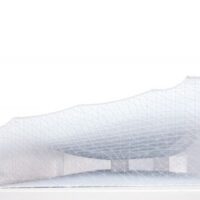
As both a secure repository of books and a symbolic civic building, a national library must negotiate the spatial dichotomy between storage and display. Through a strategy of ‘light monumentality’ the book stacks are formed into a curved two-way truss that protects and defines a public winter-garden below it. During the day, its specular surface reflects the surrounding cityscape, while at night an internal illumination reveals the massive amount of books and knowledge within. The curved form itself organizes a system of ramped stacks and reading rooms that allow new interactive relationships between books and their viewers.
-

czechlibrary_dusk

-
-

czechlibrary_books   czechlibrary_papercut

books can be seen as a surface (left).  This surface becomes volumetric as stacks are organized along a continuously sloping ramp (right).
-
-

czechlibrary_elev-day-nt

During the day, the interior curved skin reflects the urban surrounds while protecting the collections from sunlight.  During the night, the interior of the book stacks is revealed.
-
-

czechlibrary_model   czechlibrary_struct

View of model (left).  Structural diagram (right).
-
-

czechlibrary_stacks-in00

From the interior, the rear of the stacks become an organizing apparatus: the user can quickly identify the destinatiion
-
-

czechlibrary_stacks-out00

From the ground level, the sloping floor of the open stacks allows views into them: the contents of the library become shared cultural property.
-
-

czechlibrary_elev-back

view of back elevation
-
-

czechlibrary_sustainable

Sustainability strategies:
The refractive geometry of the exterior structure/skin in conjunction with the curved interior glass skin allows diffuse natural light to enter deep into the building. The winter garden combined with the curved volume is used to bring cool air from lower levels and vent rising hot air.  Rain water is filtered and reused for secondary uses including building mechanical systems and toilets.
-
-
-

dot_grey
PROJECT CREDITS:
-
architect

Jinhee Park AIA, John Hong AIA/LEED (principals in charge), Catarina Marques, Chris Minor, Nathan Fash, Ann Ha, Behrang Behin, Erik Carlson
-
structural engineer

Jaeseoung Lee (Weidlinger Associates Inc.)


RELATED PROJECTS:

asian cultural complex boston city hall hbny  
acc city hall hbny


dot_grey
index <  works cultural

-
print post print post

8 Towers

Sunday, January 18th, 2009

Ordos 100 |  Inner Mongolia | 2010

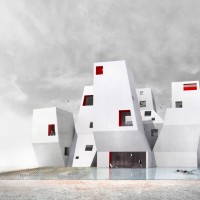
SsD was included in a gobal selection of 100 architects curated by Ai WeiWei and Herzog and deMeuron.  The abstraction of the desert site is taken as an opportunity to develop new prototypical relationships between program and efficient energy use.  Each of the 8 towers contains a separate and distinct program: entry, living, food, exercise, sleeping, and bathing. Through the distortion of each tower’s geometry, the volumes join or separate creating strategic connections and segregations so that only occupied portions of the building need to consume energy.  The organization also creates experiential differences between rooms that are necessarily similar in size, while creating a high level of both porosity and privacy.  Finally, the strategy heightens the identity and iconography of each program promoting an intensity of accidental or intentional relationships between differing activities.


ordos100_south


each tower has a distinct program   8 towers - minimal occupancy

Different zones of the home are used at different times of day. dynamically adapting building systems to these patterns of use allows for greater energy-efficiency.


ordos100_sectbath

Separating the program into separate towers forms new spatial relationships while maximizing light and air to all rooms.


ordos100_front-living

The towers rise out of the desert – clay pots are integrated into the landscape design to manage runoff during flash rain storms (above).  Although the  towers are in dense proximity to form an advantageous microclimate, the angled walls allow clear views to the sky (right).

ordos100_structure
structural diagram: towers are able to lean by keeping the centroids of volumes within foundation line


dot_grey
PROJECT CREDITS:

architect
Jinhee Park AIA, John Hong AIA/LEED (principals in charge), Brett Albert, Frederick Peter Ortner, Matt Allen, Caroline Lang, Clara Wong, Bao Wei

structural engineer
Paul Kassabian, SGH


RELATED PROJECTS:

hbny


hbny


dot_grey
index <  works residential


print post print post