SsD

architecture + urbanism

Convergent Flux – Korea Society

Convergent Flux: Korea Society New York | 2011

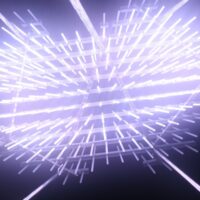
Stemming from a research project and exhibition at the Harvard Graduate School of Design, this interactive exhibition staged at the Korea Society examines contemporary Korea's architecture, landscape architecture, and urban design. The twenty-nine projects shown exemplify five interrelated themes that continue to shape modern Korea's development. The topics of historical transformation, accelerated density, topographical syntax, material identity, and infrastructural alliance, are mapped onto the wall as trajectories that converge and diverge. By utilizing a series of motion sensors that illuminate panels of information, visitors are encouraged to interactively explore each project and its relation to the themes and other projects. In parallel with the exhibit, Jinhee Park and John Hong moderated a series of lectures which included Marion Weiss and Michael Manfredi as well as organized and moderated a roundtable discussion with Taewook Cha, Felipe Correa, Mark Rakatansky, and Soo-In Yang. The research has culminated in the book, Convergent Flux: Contemporary Architecture and Urbanism in Korea.


5 themes represented by colored lines organize the exhibited projects.


The images float in front of the wall while the organizing themes appear as lines running continuously around the room.
 

Lighting behind the panels react to users' movement showing the interrelationship between projects and the 5 organizational themes. 90 minutes of video interviews with the designers give personal context to the work.
 

dot_grey
PROJECT CREDITS:

curators
Jinhee Park  + John Hong

exhibit design and fabrication
Jinhee Park AIA + John Hong AIA, LEED AP (principals in charge)
Frederick Peter Ortner, Juho Lee, Natalee Newcombe, Joe Watson

a special thanks to:
Harvard GSD, The Korea Society, The Architectural League of New York


RELATED PROJECTS:

bac-sasaki mass college of art    
bac sasaki mass art convergent flux    

dot_grey

print post print post
Share Button

Cloud

Heyri, Korea | 2012
[ Featured in Domus ]

'Cloud' is an interactive light and sound sculpture that responds to the movement of passerbys as well as to the dynamically changing weather patterns of the Heyri Art Valley in Korea. Three ethereal canopies come alive when people approach: Patterns of changing light and sound invite one to discover new paths under and between them, inspiring impromptu gatherings or even improvised performances. When not responding to people, 'Cloud' enhances the dynamic experience of the weather: detecting temperature, wind, rain, and humidity, the sculpture takes each of these conditions and creates a new link between human and atmosphere through light and sound.


Movement Sensing: As pedestrians walk to and from the waterfront their movement is dynamically sensed. Light and sound interacts differently with either individuals or groups.


Weather sensing: The dynamically changing weather patterns of the Heyri Art Valley are made more present through light and sound making new links between people and the environement.


The clouds reconnect and redefine a previously lost path between street and waterfront.


A reductive set of components are refined: diagonal columns provide cross bracing, channels house and hide electronics, acrylic rods amplify the l.e.d. lighting.


PROJECT CREDITS:

architect
Jinhee Park  AIA + John Hong  AIA, LEED AP (principals in charge), Donguk Lee, Frederick Peter Ortner, Taesoo Kim

interactive design
Jinhee Park AIA + John Hong AIA, LEED AP

sound design
xarrier infrastarwerx: jh0st (sound), vorticite (infra-poetix)

structural engineer
Park Byung-Soon

interactive engineer / fabricator
Ecofeel


RELATED WORKS:

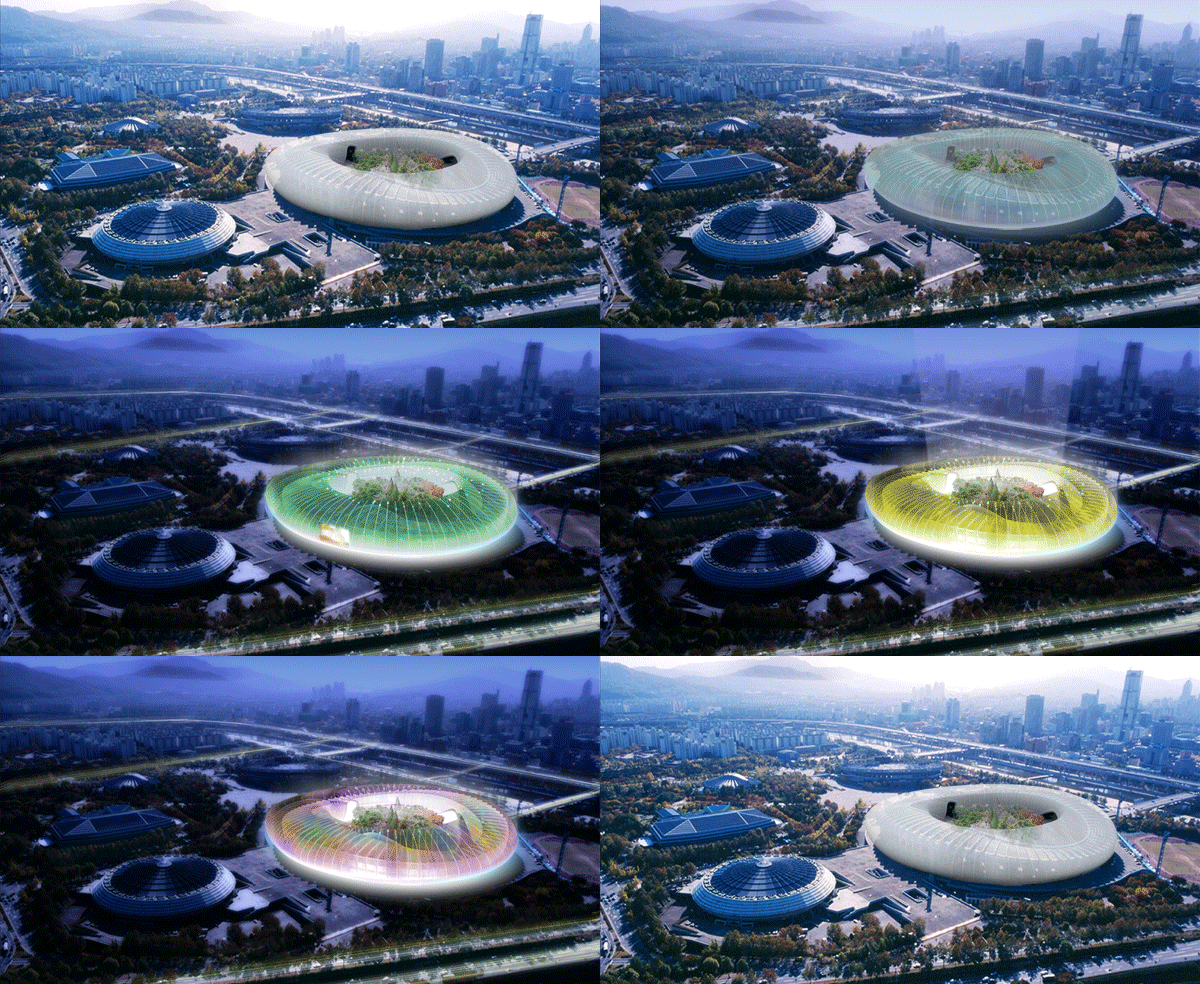
mass college of art white stadium
infinite box white block rovidence plaza mass art white stadium

dot_grey

print post print post

Share Button

White Block Gallery is Completed

 Less than 2 years ago we won the competition for the White Block Gallery.  In retrospect it feels like the project leapt from paper to reality.  Its successful completion is critical on many fronts -  It was our first building in Korea, and it was our first free-standing arthouse.  We have a lot of people to thank along the way, many of whom we hope to have credited on the project team list.  Most of all, the experience has been invaluable and we're now tooled and ready for what's next: to take on more projects in Asia, and to step further into doing work that can bring a positive effect on the public life of our cities, both at the scale of the individual and at the scale of the larger urban framework.

>> more info

Share Button

White Block ‘Supercore’ Completed

The stairs and railing of the 'super core' have been installed at White Block. This main vertical core of the building allows the varied gallery spaces a sense of interior intensity while simultaneously linking them to the exterior topographic condition.  As one progressively moves through a series of volumes, one is reoriented toward the immediate environment.

As all the galleries are adjacent to this core, motorized vents allow a constant flow of air, passively ventilating the entire building.

Share Button

White Block Gallery

Heyri, Korea | 2011
[ AIANE Design Award, AIA/BSA Honor Award, American Architecture Award ]

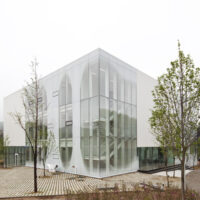
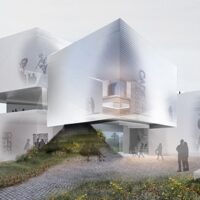
The White Block Gallery is a 1500m2 exhibition and cultural space at the heart of the Heyri Art Valley in South Korea. A matrix of 3 solid gallery volumes carefully positioned creates 7 additional galleries in a compact but open ended configuration. Designed to showcase global contemporary art from super sized sculpture and paintings to multi-media installations, the spaces are unique in proportion and lighting allowing curators to accommodate new future forms of art and media. Integration with the landscape of the prominent lake-front site is also of crucial importance: The result places the intense and controlled experience of art side-by-side with informal social and landscape interactions. Passive heating and ventilation are integrated into the art house’s high efficiency environmental systems and runoff control measures become part of the spatial experience of art.


By carefully arranging the massing of 3 solid gallery volumes, 7 more galleries are produced in the interstitial spaces to create a total of 10 proportionally varied galleries.


View of exterior: solid and void galleries are suspended in a dense matrix white maintaining views through the building.

The fritting pattern takes on more figural volumes to create areas of privacy and publicity.  The shapes merge with the patterns of early morning fog.  A functional space of the fire stair becomes a main feature as a public viewing platform at the building’s corner.
 

As the largest site in the Heyri Art Valley, the aggregation of solid and transparent boxes breaks down the overall scale of the building.  Each solid gallery box is thought of as a pavilion that is either suspended above the landscape or placed on top of it. The solid boxes capture shadows of adjacent trees while the transparent boxes reflect the distant landscape. A roofdeck on the lower ‘sitting box’ has extended views to the natural surrounds.


A compressed entry under the hovering ‘hanging box’ frames views to the waterfront beyond.  The low space is accentuated through the use of dark woods and in juxtaposition to the tall ‘supercore’ it connects to.  The entry glass is the only curved moment in the otherwise taut skin and allows one to occupy an ambiguous space between inside and outside
.

The ‘Supercore’ is an organizational void space that mediates between the autonomy of each gallery space and its connection to the surrounding landscape.  A series of bridges cross the space and become viewing platforms for artwork.


A variety of gallery spaces range in volume, lighting conditions and interconnectedness.


Unfolded section: Instead of evenly dividing up the building into 3 stories (top), the section through the building is conceived of as an interior topography (bottom), that allows exhibition spaces to vary radically in height while maintaining strict overall building height zoning regulations.


The interior ‘ground’ is conceived of as a topography that is directly linked to the landscape design.  Formal galleries for art are adjacent to informal social spaces.  The ‘stramp’ (stair and ramp hybridized) also doubles as a lecture hall and screening room.


Linked directly to the 'stramp' the 'supercore’ is an organizational void space that mediates between the autonomy of each gallery space and its connection to the surrounding landscape.  A series of bridges cross the space and become viewing platforms for artwork.


The 'supercore' and 'stramp' occupy a large window that spatially connects the front and back of the building and  reorients views to the lake and wetlands.


"High" and "low" tech strategies are used for daylighting: A parametrically developed frit pattern optimizing for daylight distribution while minimizing heat gain. (above-right). City-regulated blooming trees become part of the shading strategy in their ability to change seasonally. As the frit pattern moves from opaque to transparent, exterior trees appear to shift from outside to inside (above right and below).


Column Study: The structure is distributed across many smaller columns rather than a few larger ones increasing the visual connection between interior to the site as well as providing more curatorial freedom for the gallery spaces by eliminating structural obstructions.


As part of the larger urban and landscape setting, existing exterior paths are integrated into the interior circulation.


PROJECT CREDITS:

architect
Jinhee Park  AIA + John Hong  AIA, LEED (principals in charge)
Frederick Peter Ortner, Donguk Lee, Jiseok Park, Taesoo Kim, Christoph Schäfer, Juho Lee, Marcela Delgado, Soojung Rhee, Aleta Budd, Okhyun Kim, Eli Allen, Jeff Niemasz, Eunkyoung Cho, Brian Vester, Ryan Welch, Jeong Jun Song

associate architect
Dyne Architects

structural design
Matt Johnson, SGH Inc.

structural engineer
New Engineering

lighting consultant
Project Concept K

construction manager
Hanmi Parsons Co., Ltd.

photography
Chang Kyun Kim


RELATED WORKS:

czech library coulter house asian cultural complex  
infinite box czech library coulter house acc  

dot_grey

print post print post

Share Button

Emerald Kilometer

Thu Thiem, Vietnam | 2008

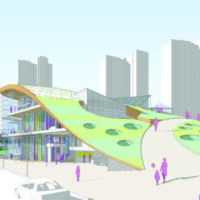
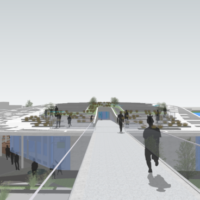
The proposed plaza, park, and bridge hosts ceremonial and everyday events in a new mixed-use district for Ho Chi Minh City in Vietnam. Our project creates a kilometer long plaza, green in its physical presence, green in its construction and dynamically scalable to the events of the city. Floating above the entire plaza and bridge is a monumental pergola, a filigree of steel cables covered in flowering vines, the patterns of the openings creating an ever changing play of shadow and light. This unifying roof turns the plaza into a single super-scaled outdoor living room. At the same time, a panoply of differently scaled openings create a series of perceptual spaces of different sizes, intimate at the lake end and becoming progressively more grand as they approach the Saigon River.


Comparison of Plaza Sizes:A network of paths and spaces defined by the landscape canopy extends over the river and creates the perception of a lengthened plaza that connects the two sections of the city.

As well as providing shade for the plaza, the urban scale canopy defines a multitude of programmatic activities and scales to animate the space around the clock.


The canopy and paving work in conjunction as a new infrastructure:  Both overhead photo-voltaics in the canopy and under-foot Piezo-electric flooring generates energy which then powers the lighting and public wi-fi installed in the canopy.  Runoff water collected from the permeable paving is filtered and re-used for public restrooms and to drip irrigate the canopy vines.

dot_grey
PROJECT CREDITS:

architect
Jinhee Park AIA + John Hong AIA, LEED (principals in charge), Jonathan Louie, Matthew Allen, Frederick Peter Ortner, Brett Albert, Daniel Cashen

landscape architect
Ground, Inc.


RELATED PROJECTS:

boston city hall mass college of art      
boston city hall mass art      

dot_grey
 

print post print post
Share Button

Boston City Hall

Boston, MA | 2007
[Architecture Boston Feature]

boston city hall

Boston City Hall occupies one of the best pieces of land in Boston. At the intersection of 3 major subway lines and at the geographical heart of downtown, this is an ideal location for a dynamic civic center; however the current City Hall is accused of failing to interface effectively with the public. We propose taking advantage of a latent urban potential: The site is the missing link between the historic Fenway Park and the new Rose Kennedy Greenway.  By allowing the plaza to connect these important open spaces, City Hall will sit pavilion-like in a park, much like a New England meeting house at the center of urban life. Opening the City Hall to its surroundings and reprogramming it with public functions such as a meeting hall, a community/ cultural center, and a civic history museum will also make it an integral part of Boston's historical 'Freedom Trail.'


connecting fenway with the greenway freedom trail

The plaza has the latent potential to provide the much needed connection between Fenway Park and the Rose Kennedy Greenway (left).  New public programs at City Hall can allow it to become a new addition to the 'Freedom Trail.' (right).


boston city hall plaza plaza lights

Revealing the red, green, and blue subway lines brings new public activity to the surface of the plaza.
 

city hall section

Section through the plaza: Natural light and ventilation brought to the subway levels can also allow for new programs to be added underneath the plaza.


PROJECT CREDITS:

architect
Jinhee Park AIA + John Hong AIA/LEED (principals in charge), Frederick Peter Ortner, Catarina Marques, Jiseok Park


RELATED PROJECTS:

asian cultural complex czech library boston harbor pavilion  
acc czech library boston harbor emerald km  

dot_grey

print post print post
 

Share Button